
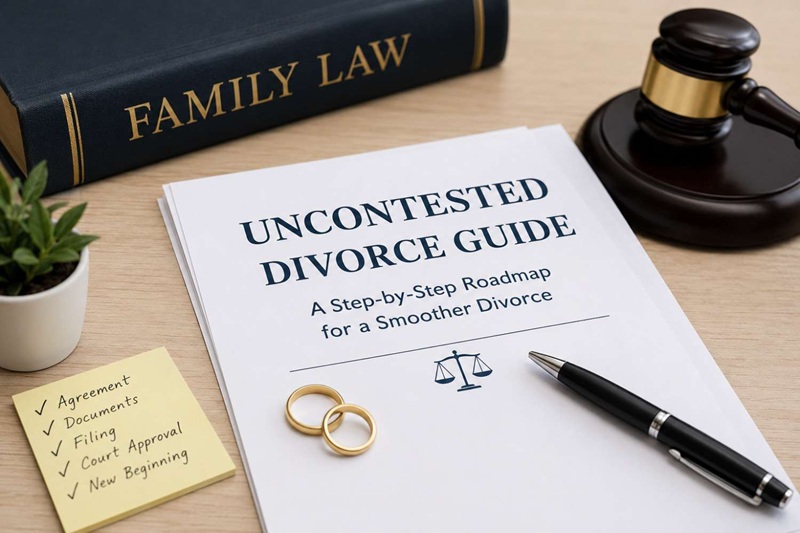
Ending a marriage is rarely easy, but it doesn’t always have to involve lengthy court battles or expensive litigation. This Uncontested Divorce Guide explains how couples who mutually agree on key issues can navigate the divorce process more efficiently while minimizing emotional and financial stress. Whether you’re considering divorce or simply researching your options, this guide provides a practical overview of eligibility, legal requirements, timelines, and common mistakes to avoid in the United States.
According to the National Center for Health Statistics (NCHS), the United States recorded 672,502 divorces (45 reporting states and the District of Columbia) in the latest provisional national statistics, demonstrating that divorce remains a significant legal process for many American families.
According to the Centers for Disease Control and Prevention (CDC), hundreds of thousands of divorces occur annually in the U.S. While every family’s circumstances are unique, many couples choose uncontested divorce because it offers a more cooperative approach than traditional contested proceedings.
What Is an Uncontested Divorce?
An uncontested divorce occurs when both spouses agree on all major issues related to ending their marriage before asking a judge to finalize the divorce.
Although divorce procedures differ by state, family courts generally require spouses to satisfy residency requirements and submit legally required forms before a divorce can be finalized. State-specific rules should always be reviewed before filing.
These issues typically include:
- Division of marital property.
- Allocation of debts.
- Child custody.
- Parenting schedules.
- Child support.
- Spousal support (alimony), if applicable.
Because the parties have already resolved these matters, the court generally spends less time reviewing the case than it would in a contested divorce.
Instead of arguing before a judge, spouses submit a written settlement agreement outlining the terms they’ve negotiated together.
Uncontested vs. Contested Divorce
| Uncontested Divorce | Contested Divorce |
|---|---|
| Mutual agreement | Significant disagreements |
| Less expensive | Higher legal costs |
| Faster resolution | Longer court process |
| Fewer hearings | Multiple court appearances |
| Lower emotional stress | Higher conflict |
| Greater privacy | More public litigation |
While uncontested divorces are generally simpler, they are only appropriate when both spouses are willing to cooperate honestly and disclose their financial information.
Who Qualifies for an Uncontested Divorce?
Not every divorce qualifies as uncontested.
Generally, couples may qualify if they agree on:
- Division of assets.
- Distribution of debts.
- Parenting responsibilities.
- Child support arrangements.
- Alimony decisions.
- Filing procedures.
They must also meet the residency requirements established by the state where they intend to file.
Because family law varies across jurisdictions, residency periods and filing procedures differ from state to state.
Benefits of Choosing an Uncontested Divorce
One reason many couples search for an Uncontested Divorce Guide is the significant advantages this process may provide.
1. Lower Legal Expenses
Traditional divorce litigation often requires:
- Multiple attorney meetings.
- Discovery requests.
- Depositions.
- Court hearings.
- Expert witnesses.
An uncontested divorce typically requires fewer legal services, helping many couples reduce overall costs.
2. Faster Resolution
Court schedules can delay contested cases for several months or even longer.
When both spouses cooperate, many uncontested divorces move through the court system much more efficiently, although the exact timeline depends on state law and mandatory waiting periods.
3. Less Emotional Stress
Divorce affects not only spouses but also children, extended families, and close friends.
Resolving disagreements through communication rather than litigation often reduces emotional strain and preserves a more respectful relationship after divorce.
4. Greater Privacy
Courtroom disputes frequently require detailed testimony regarding finances, parenting, and personal matters.
An uncontested divorce generally involves fewer hearings, helping limit public exposure of sensitive family issues.
Step-by-Step Uncontested Divorce Process
Understanding each stage can make the experience less overwhelming.
Step 1: Confirm Eligibility
Before filing, spouses should determine whether they truly agree on every significant issue.
If major disagreements remain unresolved, mediation or collaborative divorce may help before filing.
Step 2: Gather Financial Documents
Accurate financial disclosure is essential.
Common documents include:
- Tax returns.
- Pay stubs.
- Bank statements.
- Retirement accounts.
- Mortgage documents.
- Loan balances.
- Credit card statements.
- Investment accounts.
Transparent disclosure helps prevent future legal disputes.
Step 3: Prepare a Settlement Agreement
This document serves as the foundation of an uncontested divorce.
It usually addresses:
- Property division.
- Debt allocation.
- Child custody.
- Parenting schedule.
- Child support.
- Spousal support.
- Insurance responsibilities.
- Future dispute resolution.
Courts generally review the agreement to ensure it complies with state law and protects the interests of any children involved.
Step 4: File the Divorce Petition
One spouse files the required paperwork with the appropriate family court.
Depending on state procedures, filing may include:
- Petition for dissolution.
- Financial disclosures.
- Settlement agreement.
- Parenting plan.
- Child support worksheet.
Some states now allow electronic filing, while others require paper submissions.
Step 5: Serve or Waive Service
Normally, the filing spouse serves the divorce papers on the other spouse.
However, in many uncontested cases, the responding spouse signs a waiver acknowledging receipt of the documents, simplifying the process.
How Long Does an Uncontested Divorce Take?
Many people assume every uncontested divorce is finalized within a few weeks, but timelines vary considerably.
Filing timelines vary widely because each state establishes its own residency requirements, mandatory waiting periods, and court procedures. Readers should consult their state judiciary’s official website for filing requirements.
Several factors influence the overall process, including:
- State residency requirements.
- Mandatory waiting periods.
- Court workload.
- Accuracy of filed documents.
- Whether children are involved.
Some states require waiting periods even when both spouses fully agree on every issue.
Understanding these requirements before filing helps avoid unnecessary delays.
Common Mistakes to Avoid During an Uncontested Divorce
Although uncontested divorces are generally less complex than contested cases, avoidable mistakes can still delay the process or create future legal disputes.
1. Hiding Financial Information
Each spouse should fully disclose income, assets, debts, retirement accounts, and other financial obligations. Failure to do so could result in legal consequences or the agreement being challenged later.
2. Rushing Through the Settlement Agreement
A settlement agreement should clearly define each party’s rights and responsibilities. Ambiguous language regarding property division, debt allocation, or parenting schedules can lead to misunderstandings after the divorce is finalized.
3. Ignoring Future Financial Changes
Couples should consider how future events—such as job loss, relocation, or changes in a child’s needs—may affect support obligations and parenting arrangements.
4. Overlooking Retirement Assets
Pensions, 401(k)s, IRAs, and other retirement accounts are often among the largest marital assets. Depending on the circumstances, additional legal documents may be required to divide certain retirement benefits.
5. Filing Incorrect or Incomplete Forms
Family courts may reject filings that contain missing information or inaccurate documentation. Reviewing all paperwork before submission can help avoid unnecessary delays.
How Much Does an Uncontested Divorce Cost?
One of the primary reasons couples choose this process is its affordability compared to contested litigation.
Typical expenses may include:
- Court filing fees.
- Attorney consultation fees (if retained).
- Mediation costs (if needed).
- Document preparation services.
- Notary or document certification fees.
The total cost varies significantly by state and individual circumstances. Cases involving children, substantial assets, or retirement accounts may require additional legal assistance.
Uncontested Divorce When Children Are Involved
Having children does not automatically prevent an uncontested divorce. However, courts carefully review agreements affecting minor children to ensure they serve the child’s best interests.
Parents generally need to address:
- Legal custody.
- Physical custody.
- Parenting time.
- Holiday schedules.
- Decision-making responsibilities.
- Child support.
- Health insurance.
- Education expenses.
Many courts encourage parents to develop a detailed parenting plan that reduces future conflicts and promotes consistency for children.
When an Uncontested Divorce May Not Be Appropriate
While this Uncontested Divorce Guide highlights many advantages, uncontested divorce is not suitable for every situation.
You should consider seeking independent legal advice if your case involves:
- Domestic violence.
- Coercion or intimidation.
- Hidden assets.
- Complex business ownership.
- Significant disagreement over child custody.
- High-value marital estates.
- Substance abuse concerns.
- Financial misconduct.
In these circumstances, a contested divorce or another legal process may better protect your rights and interests.
Frequently Asked Questions
Is an uncontested divorce legally binding?
Yes. Once approved and signed by the court, the divorce decree becomes legally binding on both parties.
Can spouses use one attorney?
In many jurisdictions, one attorney may prepare documents for one spouse, but that attorney generally cannot represent both parties due to ethical rules. The other spouse may choose to seek independent legal advice.
Does an uncontested divorce require a court hearing?
Some states finalize uncontested divorces without requiring both spouses to appear in court, while others may schedule a brief hearing. Requirements vary by jurisdiction.
Can child custody be included?
Yes. Parents may include custody, parenting schedules, and child support agreements, subject to court approval and applicable state law.
Can an uncontested divorce become contested?
Yes. If either spouse later disagrees about property, custody, support, or another significant issue before the divorce is finalized, the matter may proceed as a contested case.
Final Thoughts
For many couples, an uncontested divorce offers a practical way to end a marriage with greater cooperation, reduced costs, and fewer court proceedings. By communicating openly, providing complete financial disclosures, and carefully preparing settlement documents, spouses can often move through the legal process more efficiently.
This Uncontested Divorce Guide is intended to help readers understand the general process, but divorce laws differ across the United States. Before making important legal decisions, consulting a qualified family law attorney can help ensure that your rights and long-term interests are protected.
The National Center for Health Statistics continues to report marriage and divorce trends annually, underscoring the importance of understanding the legal process and seeking reliable legal guidance before making major family law decisions.
https://www.cdc.gov/nchs/fastats/marriage-divorce.htm
Number of marriages: 2,041,926
Marriage rate: 6.1 per 1,000 total population
Number of divorces: 672,502 (45 reporting States and D.C.)
Divorce rate: 2.4 per 1,000 population (45 reporting States and D.C.)