
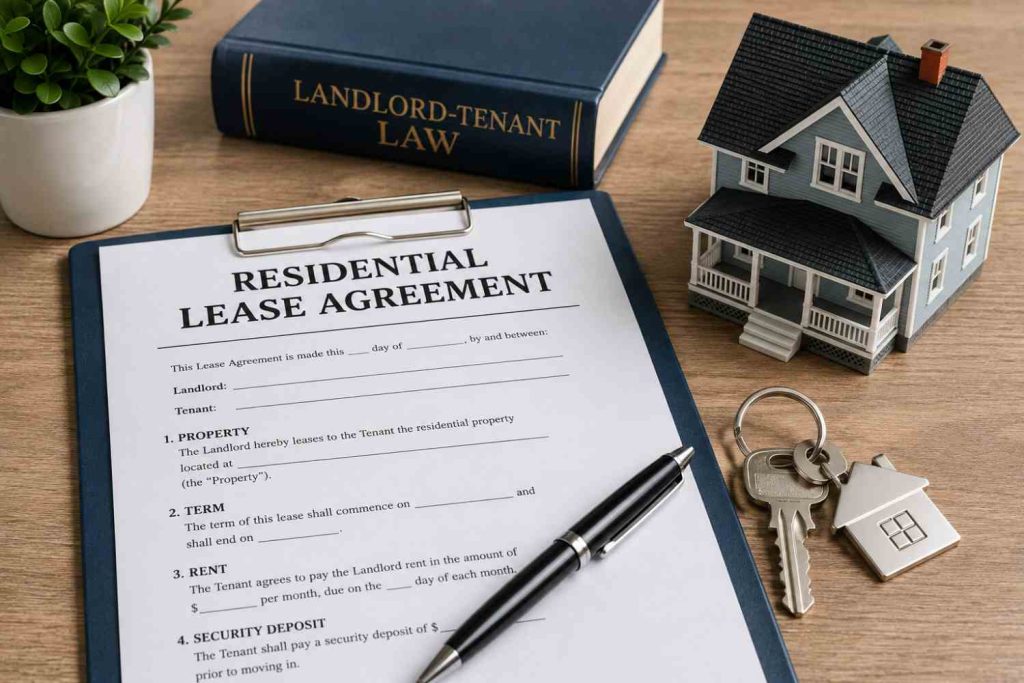
A rental relationship works best when both the landlord and tenant understand exactly what they have agreed to. Residential Lease Agreements provide a written framework for that relationship by explaining the rental property’s terms, payment obligations, responsibilities, restrictions, and procedures for ending or renewing the tenancy.
A properly prepared lease can reduce misunderstandings and give both parties a clear reference if a disagreement occurs. It can explain everything from monthly rent and security deposits to maintenance responsibilities, pets, utilities, property access, and lease termination.
However, a lease is not simply a document that protects the landlord. It also gives tenants important information about their rights and responsibilities. Because landlord-tenant laws vary between states and local jurisdictions, a lease should comply with the laws applicable to the property.
What Are Residential Lease Agreements?
Residential Lease Agreements are contracts between a property owner or landlord and a person renting a residential property.
The agreement normally establishes the terms under which the tenant can occupy and use the property.
A residential lease may identify:
- The landlord and tenant.
- The rental property’s address.
- The length of the tenancy.
- Monthly rent.
- Security deposit.
- Payment due dates.
- Utilities.
- Maintenance responsibilities.
- Property rules.
- Pet policies.
- Occupancy requirements.
- Renewal procedures.
- Lease termination conditions.
- Notice requirements.
- Restrictions on subleasing.
- Procedures for handling violations.
The exact contents can differ depending on the property, state, local regulations, and type of tenancy.
HUD’s housing counseling materials explain that lease concepts include obtaining and maintaining tenancy, lease termination, maintenance responsibilities, and resolving landlord-tenant disputes.
Why a Written Lease Matters
A verbal agreement may sometimes create a rental relationship, but relying on verbal promises can make disagreements much more difficult to resolve.
A written lease provides evidence of what the parties agreed to.
For example, suppose a tenant believes that water, electricity, and parking are included in the rent while the landlord believes the tenant must pay those costs separately. If the agreement clearly identifies who is responsible, the dispute can often be resolved by reviewing the document.
A good written lease should therefore be:
- Clear.
- Specific.
- Easy to understand.
- Consistent with applicable law.
- Signed by the appropriate parties.
- Supported by relevant property documentation.
The goal is not to make the agreement unnecessarily complicated. The goal is to eliminate avoidable uncertainty.
Essential Information in Residential Lease Agreements
A strong lease should contain enough information for both parties to understand the rental arrangement.
Names of the Parties
The agreement should identify the landlord, tenant, and, where appropriate, other authorized occupants.
Property Description
The full address should be included, along with the apartment, unit, parking space, storage area, or other relevant property details.
Lease Term
The agreement should explain when the tenancy begins and when it ends.
It should also clarify what happens when the initial term expires.
Some agreements renew automatically, while others require a new agreement or written notice.
Rent Amount
The lease should clearly state:
- Monthly rent.
- Due date.
- Payment method.
- Where or how payment should be made.
- Any legally permitted late charges.
Avoid vague language that could leave either party uncertain about the amount due.
Security Deposit
The agreement should identify the amount of the security deposit and explain how it will be handled, subject to applicable law.
Because security-deposit requirements differ by jurisdiction, landlords should make sure the lease does not conflict with local requirements.
Lease Terms and Tenant Responsibilities
A tenant’s responsibilities should be clearly explained before the lease is signed.
Common responsibilities may include:
- Paying rent on time.
- Keeping the property reasonably clean.
- Reporting maintenance problems.
- Avoiding intentional or negligent damage.
- Following occupancy rules.
- Complying with reasonable property policies.
- Following applicable pet restrictions.
- Avoiding unauthorized alterations.
- Returning the property as required when the tenancy ends.
A lease should distinguish between ordinary use and conduct that creates actual property damage.
Tenants should also understand that signing a lease can create enforceable obligations. HUD housing counseling guidance specifically notes that lease terms can affect a tenant’s right to use and enjoy the property and can create consequences for early termination.
Landlord Responsibilities Under a Lease
Residential lease agreements also establish expectations for landlords.
Depending on applicable law, landlords may have responsibilities involving:
- Maintaining the rental property.
- Addressing significant repair issues.
- Providing required services.
- Respecting tenant privacy.
- Following legal entry requirements.
- Maintaining required safety standards.
- Handling security deposits according to applicable rules.
- Following lawful procedures when ending a tenancy.
A lease should not be used to eliminate mandatory protections provided by state or local law.
If a particular housing requirement is legally mandatory, a private contract generally cannot simply erase that obligation.
Rent and Payment Terms
Rent is one of the most important parts of a lease.
A well-written agreement should answer basic questions such as:
How much is the rent?
When is it due?
How can it be paid?
What happens if payment is late?
Are additional fees permitted?
Who pays utilities?
Clear answers reduce the possibility of disputes.
Tenants should keep evidence of rent payments, including receipts, bank records, online payment confirmations, or other documentation.
Landlords should also maintain accurate payment records.
Security Deposits in Residential Lease Agreements
Security deposits can protect landlords against certain qualifying losses, but they are regulated in many jurisdictions.
Depending on local law, landlords may have specific requirements concerning:
- The maximum deposit.
- Where the deposit is held.
- Interest.
- Permitted deductions.
- Move-in inspections.
- Move-out inspections.
- Deposit accounting.
- Return deadlines.
Tenants should inspect the property before moving in and document existing damage with photographs or written inspection reports.
This is particularly useful because it can help distinguish pre-existing conditions from damage that occurred during the tenancy.
Landlords should likewise keep detailed records of the property’s condition.
Maintenance and Repair Responsibilities
One of the most important sections of Residential Lease Agreements concerns maintenance.
The agreement should explain which responsibilities belong to the landlord and which belong to the tenant, while still complying with applicable housing laws.
Potential landlord responsibilities can include major systems and habitability-related issues.
Tenant responsibilities may include routine care, keeping the property reasonably clean, and reporting problems.
A useful lease should also explain how tenants should report repairs.
For example, the agreement might specify:
- An online maintenance portal.
- Email.
- Written notice.
- Emergency telephone contact.
- Property management office.
Clear reporting procedures can help ensure that important problems are communicated quickly.
Rules About Property Access
Although landlords own the property, tenants generally receive a right to occupy and use the rental during the lease term.
As a result, property access should be addressed carefully.
Depending on state and local law, landlords may be permitted to enter for reasons such as:
- Repairs.
- Maintenance.
- Inspections.
- Showing the property.
- Emergencies.
- Other legally recognized purposes.
Notice requirements can apply.
The lease should explain the general procedure while remaining consistent with applicable law.
Pets and Occupancy Rules
If a landlord has lawful pet restrictions, those rules should be clearly written into the lease.
The agreement may address:
- Whether pets are permitted.
- Types or numbers of pets.
- Pet-related charges where legally permitted.
- Cleaning responsibilities.
- Damage caused by pets.
- Rules for common areas.
However, landlords should distinguish between ordinary pets and disability-related assistance animals because different legal requirements may apply.
Similarly, occupancy restrictions should be reasonable and consistent with applicable housing laws.
Residential Lease Agreements and Fair Housing
A lease cannot legally be used as a tool for unlawful housing discrimination.
The Fair Housing Act prohibits discrimination in housing based on characteristics including race, color, religion, sex, national origin, familial status, and disability. The U.S. Department of Justice explains that these protections apply to direct housing providers such as landlords and real estate companies.
This means landlords should use consistent criteria when:
- Advertising a property.
- Evaluating applications.
- Setting rental terms.
- Applying property rules.
- Renewing leases.
- Ending tenancies.
A consistent process can help reduce both legal risk and confusion.
Tenant Screening and the Lease
Before signing Residential Lease Agreements, landlords may screen prospective tenants.
Screening can involve:
- Credit information.
- Rental history.
- Eviction records.
- Employment or income information.
- References.
- Background information.
Federal consumer-reporting requirements can apply when landlords use tenant screening reports.
The Federal Trade Commission explains that tenant background reports may contain rental history, eviction history, credit information, or criminal records, and that landlords using consumer reports for housing decisions must comply with the Fair Credit Reporting Act.
The FTC also explains that certain negative decisions based on consumer reports can trigger adverse-action requirements.
This makes proper screening procedures an important part of the rental process.
Lease Renewal and Rent Changes
A lease should explain what happens when the initial rental term approaches its end.
Possible arrangements include:
- Automatic renewal.
- Month-to-month tenancy.
- New fixed-term lease.
- Notice of non-renewal.
Rent changes may also be subject to state or local rules.
Landlords should not assume that they can change rent, fees, or other major terms at any time simply because they own the property.
Tenants should review renewal notices carefully and check whether the proposed changes comply with applicable law and the existing agreement.
Ending Residential Lease Agreements
A lease should explain how the tenancy can end.
Common situations include:
- The fixed term expires.
- The tenant provides required notice.
- The landlord provides legally required notice.
- Both parties agree to terminate.
- A serious lease violation occurs.
- The property becomes unavailable under circumstances recognized by law.
The required notice period can depend on the type of tenancy and the reason for termination.
A landlord should never rely solely on a lease provision if applicable law requires a different procedure.
Early Termination of a Lease
Sometimes a tenant wants to leave before the lease expires.
The consequences depend on the lease and applicable law.
The agreement may explain:
- Required notice.
- Early termination fees where legally permitted.
- Re-letting procedures.
- Responsibility for unpaid rent.
- Security-deposit treatment.
- Circumstances that may permit early termination under law.
Tenants should not simply move out without understanding the potential financial and legal consequences.
At the same time, landlords should understand that certain laws may provide tenants with special rights to terminate a lease under qualifying circumstances.
What Happens When a Lease Is Violated?
A lease violation does not necessarily mean that the landlord can immediately remove a tenant.
The appropriate response depends on:
- The type of violation.
- The language of the lease.
- Applicable state law.
- Local regulations.
- Required notice.
- Whether the violation can be corrected.
A landlord should document the problem and follow the legally required procedure.
Tenants who receive a violation notice should read it carefully and respond within the required time-frame.
Research Data: The Size of the Rental Market
The importance of clear Residential Lease Agreements becomes easier to understand when looking at the size of the rental market.
U.S. Census Bureau data report approximately 45.2 million renter-occupied housing units among roughly 129.9 million occupied housing units in the United States in the relevant American Community Survey estimates.
That means rental housing represents a substantial part of the nation’s occupied housing stock.
The Census Bureau also reported a national median gross rent of approximately $1,300 per month for renter-occupied housing units paying cash rent in the corresponding survey data.
These figures demonstrate why clear rental contracts matter. When millions of households depend on rental housing, even seemingly small misunderstandings about rent, maintenance, deposits, or termination can affect a large number of people.
Research referral: U.S. Census Bureau — Housing Tenure Data
Research referral: U.S. Census Bureau — Median Gross Rent Data
Special Considerations for Housing Assistance Programs
Some rental properties are subject to additional requirements because they participate in federal or other housing assistance programs.
For example, HUD’s Housing Choice Voucher program uses additional documentation and requirements alongside the ordinary rental lease. HUD explains that a tenancy addendum can supplement the rental lease, and where the addendum conflicts with a lease provision, the applicable program addendum takes precedence.
This illustrates an important point: not every rental agreement operates under exactly the same rules.
Landlords and tenants participating in subsidized housing programs should review all applicable program documents rather than relying exclusively on a standard private lease.
Common Mistakes When Creating Residential Lease Agreements
Even a basic lease can become problematic when important details are left unclear.
Using a Generic Lease Without Checking Local Law
A form downloaded from the internet may not comply with the laws of the property’s jurisdiction.
Leaving Important Terms Vague
Unclear rules about utilities, maintenance, pets, parking, or renewal can create disputes.
Adding Unenforceable Clauses
A lease should not contain provisions that conflict with mandatory legal protections.
Failing to Document Property Condition
Move-in photographs and inspection reports can be valuable for both parties.
Not Explaining Notice Requirements
Both landlords and tenants should understand how much notice is required for relevant actions.
Ignoring Changes to the Agreement
If the parties agree to change a material term, the change should generally be documented appropriately rather than relying on an informal conversation.
How to Make a Better Residential Lease Agreement
A practical lease should be:
Clear: Use straightforward language.
Complete: Cover the major financial, property, and tenancy terms.
Consistent: Make sure individual provisions do not contradict one another.
Lawful: Check state and local requirements.
Documented: Keep signed copies and supporting records.
Accessible: Both parties should receive a copy they can reference throughout the tenancy.
A strong lease is not necessarily the longest lease. It is the one that clearly communicates the agreement while complying with applicable law.
Residential Lease Agreements Checklist
Before signing a rental agreement, landlords and tenants should review:
- Names of all relevant parties.
- Full property address.
- Lease start and end dates.
- Monthly rent.
- Rent due date.
- Payment method.
- Security deposit.
- Utility responsibilities.
- Maintenance responsibilities.
- Property access rules.
- Pet rules.
- Occupancy requirements.
- Subleasing rules.
- Renewal provisions.
- Termination requirements.
- Notice procedures.
- Late-payment provisions.
- Property-condition documentation.
- Signatures and copies.
Frequently Asked Questions About Residential Lease Agreements
What is a residential lease agreement?
A residential lease agreement is a contract between a landlord and tenant that establishes the terms under which the tenant may occupy and use a residential property.
What should a residential lease agreement include?
It should generally identify the parties and property and explain rent, deposits, lease duration, maintenance, utilities, property rules, renewal, termination, and other important responsibilities.
Can a landlord change the lease after it is signed?
Generally, a landlord cannot simply rewrite a fixed-term agreement whenever they want. Changes usually require compliance with the lease and applicable law, and the parties may need to agree to modifications.
Can a tenant leave before the lease ends?
A tenant may be able to terminate early in certain circumstances, but the consequences depend on the lease and applicable law. Some laws also provide special termination rights in qualifying situations.
Are all residential lease agreements the same?
No. Requirements can differ by state, city, property type, housing program, and tenancy arrangement.
Is a written lease always required?
The requirements for written leases vary by jurisdiction and circumstances. Even where a written agreement is not strictly required, having one is generally useful because it creates a clear record of the parties’ expectations.
Can a lease contain any rule the landlord wants?
No. Lease provisions generally must comply with applicable law. A private agreement cannot necessarily eliminate mandatory tenant protections or authorize unlawful discrimination.
Final Thoughts
Residential Lease Agreements are more than paperwork. They establish the foundation of the landlord-tenant relationship and provide both parties with a clear understanding of their financial, property, and legal responsibilities.
A well-prepared agreement should clearly explain rent, deposits, maintenance, utilities, property access, pets, occupancy, renewal, termination, and other important conditions. At the same time, it must comply with federal, state, and local requirements.
For landlords, a carefully prepared lease can reduce disputes and improve property management. For tenants, reading the agreement before signing can help prevent unexpected costs and misunderstandings.
The best Residential Lease Agreements are clear, complete, legally compliant, and easy for both parties to understand. Because rental laws differ considerably across jurisdictions, landlords and tenants should check the rules that apply to the specific property and consider qualified legal assistance when dealing with complicated situations.
Important: This article is intended for general educational purposes and does not constitute legal advice. Rental laws vary by jurisdiction, and a qualified local attorney or housing professional should be consulted for advice about a specific lease or dispute.