
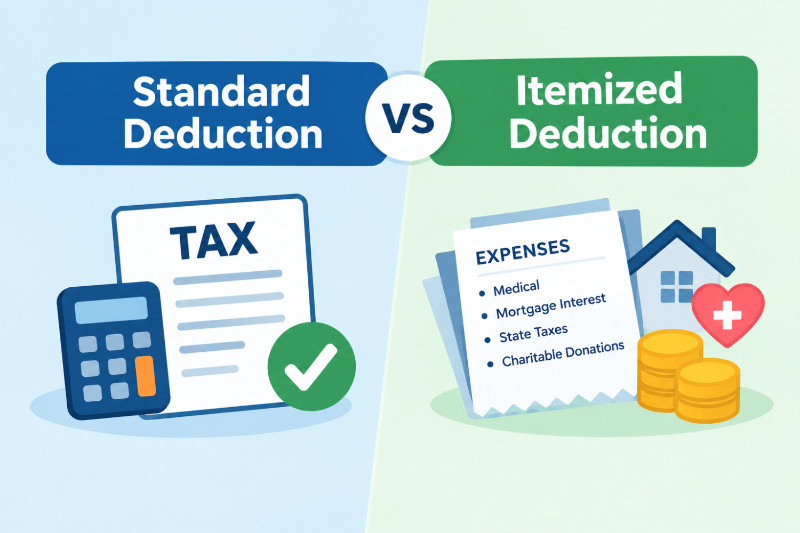
When filing a federal income tax return in the United States, taxpayers generally have a choice between taking the Standard Deduction vs Itemized Deduction. Both methods can reduce taxable income, but they work differently. The standard deduction provides a predetermined amount based on your filing status, while itemizing requires you to calculate and document eligible expenses. Understanding the difference can help you determine which deduction method may reduce your taxable income more effectively.
What Is a Tax Deduction?
A tax deduction reduces the amount of income that is subject to federal income tax. It is different from a tax credit, which generally reduces the tax itself.
For example, if your adjusted gross income (AGI) is $70,000 and you qualify for a $14,600 deduction, your taxable income could be reduced to $55,400 before considering other applicable adjustments or deductions.
The IRS explains that taxpayers generally choose between the standard deduction and itemized deductions, and taxpayers who itemize cannot also claim the standard deduction for the same return.
What Is the Standard Deduction?
The standard deduction is a fixed amount that eligible taxpayers can subtract from income without listing individual deductible expenses on Schedule A.
For tax year 2024, the federal standard deduction amounts are:
| Filing Status | 2024 Standard Deduction |
|---|---|
| Single | $14,600 |
| Married Filing Jointly | $29,200 |
| Head of Household | $21,900 |
| Married Filing Separately | $14,600 |
The IRS also provides additional standard deduction amounts for taxpayers who are age 65 or older or blind, subject to the applicable rules.
The standard deduction is straightforward because taxpayers do not need to total qualifying expenses to claim the basic amount. However, keeping tax records is still important because other parts of a tax return may require supporting documentation.
What Are Itemized Deductions?
Itemized deductions allow eligible taxpayers to deduct certain qualifying expenses instead of taking the standard deduction.
Itemized deductions are generally reported on Schedule A (Form 1040). Depending on the taxpayer’s circumstances, qualifying expenses can include:
- Certain medical and dental expenses
- State and local taxes
- Real estate taxes
- Certain mortgage interest
- Qualified charitable contributions
- Certain casualty and theft losses
- Certain other expenses allowed under federal tax law
Each category has its own eligibility requirements and limitations. Therefore, an expense should not automatically be treated as deductible simply because it appears to be a personal or financial expense.
The IRS states that taxpayers should generally itemize when their allowable itemized deductions are greater than their standard deduction, although some taxpayers are required to itemize because they cannot use the standard deduction.
Standard Deduction vs Itemized Deduction: Key Differences
The biggest difference between the two methods is how the deduction is calculated.
| Feature | Standard Deduction | Itemized Deduction |
|---|---|---|
| Calculation | Fixed amount based mainly on filing status | Based on qualifying expenses |
| Schedule A | Not required for the deduction | Required |
| Record keeping | Generally simpler | More detailed |
| Receipts and documentation | Still important for tax records | Particularly important |
| Best suited to | Taxpayers without large deductible expenses | Taxpayers with substantial eligible expenses |
| Can both be claimed? | No | No |
In simple terms, the standard deduction offers simplicity, while itemizing may be useful when qualifying deductions add up to more than the standard deduction.
How Does the Standard Deduction Work?
Suppose a single taxpayer has $70,000 of adjusted gross income and qualifies for the $14,600 standard deduction for 2024.
A simplified calculation would look like this:
AGI: $70,000
Standard deduction: $14,600
Income after deduction: $55,400
This is only an illustration. Actual taxable income can be affected by other adjustments, deductions, exemptions that apply under specific rules, and other tax provisions.
One advantage of the standard deduction is that the taxpayer does not have to calculate individual Schedule A expenses to claim the basic deduction.
How Does Itemizing Work?
Now suppose another taxpayer has qualifying expenses that may be included on Schedule A:
- State and local taxes: $8,000
- Mortgage interest: $12,000
- Qualified charitable contributions: $7,000
- Eligible medical expenses: $4,000
The taxpayer cannot simply add every expense and assume the entire amount is deductible. Different rules and limitations may apply to each category.
After applying the applicable federal tax rules, if the taxpayer’s allowable itemized deductions exceed the available standard deduction, itemizing may reduce taxable income by a larger amount.
The IRS specifically notes that taxpayers should compare their allowable itemized deductions with the standard deduction before deciding which method to use.
Standard Deduction vs Itemized Deduction: Which Expenses Matter Most?
Certain financial situations make itemizing more relevant.
1. Homeowners With Mortgage Interest
Homeowners may have deductible mortgage interest that can contribute to their Schedule A total, subject to federal limitations and eligibility requirements.
Mortgage interest is therefore one of the expenses homeowners may want to review when comparing the two deduction methods.
2. State and Local Taxes
Certain state and local taxes can be included as itemized deductions, subject to federal limitations.
The IRS identifies state and local income or sales taxes and certain property taxes among the categories that may qualify.
3. Charitable Contributions
Eligible charitable donations can potentially increase a taxpayer’s itemized deduction total.
However, the contribution must meet applicable IRS requirements, and documentation is important. The organization, type of contribution and amount can affect how the deduction is treated.
4. Medical and Dental Expenses
Certain unreimbursed medical and dental expenses may qualify for an itemized deduction when the applicable requirements and thresholds are met.
This means simply having medical expenses does not necessarily mean the entire amount can be deducted.
What Does IRS Research Tell Us?
IRS Statistics of Income data demonstrates how frequently taxpayers use each approach.
For tax year 2022, the IRS reported that approximately 88.6% of individual income tax returns claimed a standard deduction, while approximately 9.5% claimed itemized deductions. The IRS reported total standard deductions of approximately $2.60 trillion, compared with approximately $699.6 billion in itemized deductions.
The IRS’s underlying Statistics of Income data also reported approximately 142.8 million returns claiming a standard deduction and approximately 15.3 million returns reporting itemized deductions for 2022.
These statistics provide useful context: the standard deduction was used by substantially more taxpayers in that tax year, although the appropriate choice for an individual taxpayer depends on that taxpayer’s circumstances.
Research source: IRS Statistics of Income – Individual Income Tax Returns, Preliminary Data
When Should You Consider the Standard Deduction?
The standard deduction may be appropriate to consider when:
- You have relatively few qualifying itemized expenses.
- Your allowable itemized deductions are below the standard deduction.
- You prefer a simpler tax-return calculation.
- You do not have significant mortgage interest, qualifying charitable contributions, deductible taxes or other itemizable expenses.
For many taxpayers, calculating the standard deduction is considerably simpler than gathering and calculating numerous Schedule A expenses.
When Should You Consider Itemizing?
Itemizing may be worth evaluating when:
- You have significant deductible mortgage interest.
- You have substantial qualifying state and local taxes.
- You made sizeable eligible charitable contributions.
- You had significant qualifying medical and dental expenses.
- You experienced certain qualifying casualty or theft losses.
- Your allowable itemized deductions exceed your standard deduction.
The key is not the amount you spent overall. The important figure is the amount that is actually deductible under federal tax law.
A Simple Example
Consider a married couple filing jointly.
Assume their allowable itemized deductions are:
- Mortgage interest: $18,000
- State and local taxes: $10,000
- Qualified charitable contributions: $5,000
Their total potentially allowable itemized deductions are $33,000, assuming all amounts meet the applicable requirements.
For 2024, the standard deduction for married couples filing jointly is $29,200.
In this simplified example:
Standard deduction: $29,200
Potential itemized deductions: $33,000
The itemized amount is higher, so the taxpayers would generally compare the applicable Schedule A calculation against the standard deduction and consider whether itemizing produces the larger deduction.
Actual tax returns can be more complicated because deduction limits, filing circumstances and other provisions may affect the final calculation.
Important: A Bigger Deduction Does Not Mean a Dollar-for-Dollar Tax Refund
This is one of the most common misunderstandings about deductions.
A deduction reduces taxable income; it does not normally reduce the tax bill by the exact same dollar amount.
For example, a $5,000 additional deduction does not automatically create a $5,000 tax refund.
The actual tax impact depends on factors such as taxable income, filing status, applicable tax rates and other components of the tax return.
Can You Claim Both Standard and Itemized Deductions?
Generally, no.
A taxpayer generally chooses either the standard deduction or itemized deductions for the same federal income tax return. The IRS explains that taxpayers who itemize cannot also take the standard deduction.
There are, however, other deductions that may be available outside Schedule A depending on the taxpayer’s circumstances. These should not be confused with choosing between the standard deduction and itemized deductions.
What Records Should You Keep?
Good documentation is particularly important when itemizing.
Depending on your situation, records may include:
- Mortgage interest statements
- Property tax records
- State and local tax documentation
- Donation receipts
- Medical expense records
- Relevant insurance documentation
- Other records supporting deductible expenses
For charitable contributions and other deductions, specific substantiation requirements can apply. Keeping organized records can make tax preparation easier and help support deductions if the IRS asks for documentation.
Standard Deduction vs Itemized Deduction: A Practical Way to Compare
Instead of automatically choosing one method, follow these steps:
Step 1: Determine your filing status.
Your filing status affects the standard deduction amount.
Step 2: Find your applicable standard deduction.
For 2024, use the IRS amount applicable to your filing status and circumstances.
Step 3: Gather potential itemized deductions.
Review mortgage interest, qualifying taxes, charitable contributions, eligible medical expenses and other Schedule A categories.
Step 4: Apply the applicable limitations.
Not every expense is fully deductible.
Step 5: Compare the two totals.
Compare your allowable itemized deductions with your available standard deduction.
Step 6: Keep supporting documentation.
Regardless of which method you use, retain relevant tax records according to applicable record-keeping requirements.
Final Thoughts
Understanding the Standard Deduction vs Itemized Deduction is an important part of preparing a U.S. federal income tax return. The standard deduction provides a simpler predetermined deduction, while itemizing allows eligible taxpayers to calculate qualifying expenses individually.
The right approach depends on your filing status, income, eligible expenses and the tax rules applicable to your situation. Rather than assuming that itemizing is always better—or that the standard deduction is always the easiest choice—calculate both possibilities and compare the allowable amounts.
For complicated tax situations, particularly those involving substantial medical expenses, real estate, charitable contributions, business interests or unusual deductions, consider consulting a qualified tax professional.
Note: This article provides general educational information about U.S. federal income tax deductions and is not individualized tax, legal or financial advice. Tax rules can change, and state income-tax rules may differ from federal rules. Always check the applicable IRS guidance for your tax situation.