
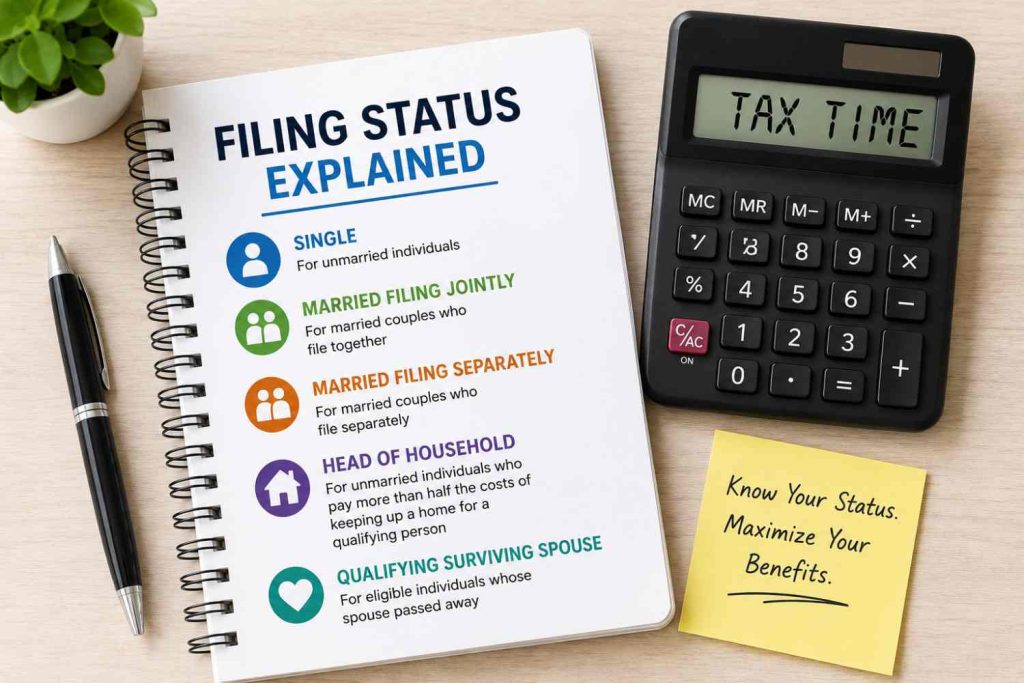
Filing Status Explained is an important topic for anyone preparing a U.S. federal income tax return. Your filing status can affect how much tax you owe, which tax credits you may claim, the standard deduction available to you, and whether you qualify for certain tax benefits. Choosing the correct status is therefore more than simply checking a box on a tax return.
The Internal Revenue Service recognizes five primary filing statuses: Single, Married Filing Jointly, Married Filing Separately, Head of Household, and Qualifying Surviving Spouse. Each category has specific eligibility requirements, and your personal circumstances determine which one you can use.
In many cases, more than one filing status may appear possible. However, taxpayers must satisfy the applicable requirements before choosing a status. The IRS explains that filing status can affect tax liability, credits, filing requirements, the type of return used, the standard deduction, and the possibility of receiving a refund.
This guide explains each filing status in plain language and highlights the factors taxpayers should consider before submitting a federal income tax return.
What Is a Tax Filing Status?
A filing status is the category the IRS uses to determine how a taxpayer should file a federal income tax return.
Your status generally depends on your marital and household circumstances. In particular, the IRS generally looks at your situation on the last day of the tax year when determining your filing status.
Your filing status can influence several parts of your tax calculation, including:
- Federal income tax rates.
- Standard deduction.
- Eligibility for certain tax credits.
- Filing requirements.
- Tax return preparation.
- Certain income thresholds.
- Eligibility for particular deductions and benefits.
For this reason, selecting the correct status should be one of the first steps when preparing a return.
The Five Federal Filing Statuses
The IRS recognizes five main filing statuses:
- Single.
- Married Filing Jointly.
- Married Filing Separately.
- Head of Household.
- Qualifying Surviving Spouse.
Although these categories may sound straightforward, each one has specific rules.
For example, simply being unmarried does not automatically mean that Single is your best or only option. If you meet the requirements for Head of Household, that status may apply instead.
Similarly, a married couple does not necessarily have to file a joint return. Married taxpayers may generally choose between Married Filing Jointly and Married Filing Separately, provided they meet the applicable requirements.
1. Single Filing Status
The Single filing status generally applies to taxpayers who are unmarried, divorced, or legally separated under applicable state law and who do not qualify for another filing status.
Your marital status on the last day of the tax year generally determines whether you are considered married or unmarried for federal tax purposes.
Single status may apply to someone who:
- Has never married.
- Is divorced.
- Is legally separated under a qualifying decree.
- Is widowed but does not qualify for another filing status.
However, unmarried taxpayers should not automatically choose Single.
If an unmarried taxpayer maintains a home for a qualifying person and meets the other requirements, Head of Household may be available.
Example
Imagine a taxpayer who is unmarried and supports a qualifying child who lives with them for the required period.
Although the taxpayer is legally unmarried, Head of Household may provide the appropriate filing status if all requirements are satisfied.
Therefore, unmarried taxpayers should review both Single and Head of Household requirements before filing.
2. Married Filing Jointly
Married Filing Jointly allows spouses to combine their income, deductions, credits, and other applicable tax information on one federal tax return.
Generally, married couples who agree to file together can use this status.
A joint return may offer advantages because the tax brackets and standard deduction can be more favorable than those available under Married Filing Separately. However, the actual result depends on the couple’s individual financial circumstances.
The IRS notes that most married couples save money by filing jointly, although taxpayers should compare their options when appropriate.
Potential Advantages
Married Filing Jointly may provide:
- Access to broader tax brackets.
- A larger standard deduction.
- Eligibility for certain tax credits that may be limited or unavailable to separate filers.
- Simpler reporting of combined household income.
- Potentially lower overall federal income tax.
Joint Responsibility
One important consideration involves responsibility for the information reported on a joint return.
When spouses file jointly, both generally become responsible for the tax reported on the return, including situations involving underreported tax.
For that reason, married couples should review their return carefully before filing.
3. Married Filing Separately
Married Filing Separately allows spouses to file individual federal income tax returns instead of combining their tax information on one return.
This option may be useful in certain circumstances, although it often produces a higher combined tax bill than filing jointly.
A taxpayer might consider this status when:
- Spouses want separate financial responsibility.
- One spouse has complicated tax circumstances.
- Filing separately produces a better overall result.
- The spouses cannot or do not want to file a joint return.
- Certain deductions or liabilities make separate filing appropriate.
However, Married Filing Separately can restrict or reduce eligibility for certain tax benefits.
For example, some credits and deductions have different rules or limitations for taxpayers who file separately.
Therefore, married couples should generally calculate their tax under both approaches when the outcome is uncertain.
4. Head of Household
Head of Household is one of the filing statuses that taxpayers most frequently misunderstand.
Being unmarried does not automatically qualify someone for this status.
Generally, a taxpayer must meet several conditions, including being unmarried or considered unmarried, paying more than half the cost of maintaining a home, and having a qualifying person under the applicable rules.
The IRS identifies three major areas that taxpayers must satisfy when claiming Head of Household:
- Filing status requirements.
- Qualifying person requirements.
- Cost of maintaining the household requirements.
Paying More Than Half the Household Costs
The taxpayer generally must pay more than half the cost of keeping up the home.
Eligible household costs can include expenses such as:
- Rent.
- Property taxes.
- Mortgage interest.
- Utilities.
- Home insurance.
- Food consumed in the home.
- Certain repairs and maintenance.
The exact rules can be detailed, so taxpayers should review IRS guidance carefully.
Qualifying Person
A qualifying person may include a qualifying child or certain qualifying relatives.
Special rules can apply depending on the relationship and living arrangements.
For example, a qualifying child generally must satisfy specific relationship, residency, age, and other requirements.
A parent can also qualify under particular circumstances even if the parent does not live with the taxpayer.
Because Head of Household can affect tax rates and deductions, taxpayers should confirm eligibility rather than assuming they qualify.
5. Qualifying Surviving Spouse
Qualifying Surviving Spouse is designed to provide certain tax benefits to eligible taxpayers after the death of a spouse.
Generally, a taxpayer may qualify if their spouse died during a qualifying period, the taxpayer has a dependent child, and the taxpayer meets other IRS requirements.
This status can allow an eligible taxpayer to use tax treatment similar to Married Filing Jointly for a limited period.
The IRS explains that a qualifying surviving spouse may generally use the joint-return tax rates and the applicable standard deduction, subject to the requirements for the status.
This status can provide important tax relief during a period when household finances may have changed significantly.
However, eligibility depends on several conditions, so taxpayers should review the IRS rules carefully.
How Filing Status Affects Your Taxes
One of the most important points in Filing Status Explained is understanding how much this selection can influence the final tax calculation.
Your filing status can affect:
Tax Rates
Different filing statuses have different income ranges for federal tax brackets.
Consequently, two taxpayers with similar taxable income may have different tax liabilities if they use different filing statuses.
Standard Deduction
The standard deduction changes according to filing status.
For the tax rules applicable to the publication period, the standard deduction amounts included:
| Filing Status | Standard Deduction |
|---|---|
| Single | $14,600 |
| Married Filing Separately | $14,600 |
| Head of Household | $21,900 |
| Married Filing Jointly | $29,200 |
| Qualifying Surviving Spouse | $29,200 |
The IRS published these amounts as part of its inflation-adjusted tax provisions.
Tax Credits
Your filing status can also affect eligibility for certain tax credits.
Some credits have income limits or specific filing-status requirements.
For example, taxpayers who file Married Filing Separately may face restrictions that do not apply to taxpayers who file jointly.
Filing Requirements
The income threshold for filing a tax return can also depend on filing status.
Therefore, determining your status can be important even before you begin preparing the actual return.
Research Data: More Than 144 Million Individual Returns Received
IRS filing-season statistics demonstrate the enormous scale of the federal tax system.
According to IRS data for the relevant filing period, the agency had received approximately 144.02 million individual income tax returns and processed about 141.32 million returns by the reporting date.
The IRS also reported approximately 137.39 million electronically filed returns.
In addition, the agency reported approximately 93.94 million refunds, totaling about $269.49 billion, with an average refund of approximately $2,869.
The data highlights why accurate filing information matters. With millions of returns processed electronically and billions of dollars issued in refunds, even basic errors involving filing status can potentially affect the taxpayer’s final result.
Research Source: IRS Filing Season Statistics
How Marriage Can Change Your Filing Status
Marriage can significantly change a taxpayer’s federal tax situation.
If you marry before the end of the tax year, the IRS generally considers you married for the entire tax year for federal filing-status purposes.
A married couple may generally choose between:
- Married Filing Jointly
- Married Filing Separately
The best choice depends on the couple’s income, deductions, credits, liabilities, and other circumstances.
For many couples, filing jointly produces a lower combined tax liability.
However, taxpayers should not assume that result without checking their individual circumstances.
How Divorce Can Affect Filing Status
Divorce can also change a taxpayer’s filing status.
If a divorce or legal separation becomes final before the end of the tax year, the taxpayer may generally be considered unmarried for federal tax purposes.
However, being divorced does not automatically mean that Single is the only option.
A taxpayer who supports a qualifying child or another qualifying person may potentially qualify for Head of Household.
Therefore, taxpayers going through divorce should carefully review their household, support, and dependent circumstances before selecting a filing status.
What Happens If You Live Apart From Your Spouse?
Living separately from a spouse does not automatically mean that a taxpayer can file as Single or Head of Household.
Special rules determine when a married taxpayer may be considered unmarried for tax purposes.
For example, the IRS explains that a taxpayer may need to live apart from their spouse during the last six months of the tax year and satisfy additional requirements to qualify as unmarried for Head of Household purposes.
Consequently, taxpayers who live apart from their spouse should review the specific IRS requirements rather than relying solely on their living arrangement.
Filing Status and Dependents
Dependents can play an important role in determining whether someone qualifies for certain filing statuses.
Head of Household, in particular, often depends on having a qualifying person.
However, taxpayers should remember that dependency rules and filing-status rules are related but not identical.
A person may qualify as a dependent under one set of rules without automatically making another taxpayer eligible for every tax benefit.
For this reason, taxpayers should evaluate each requirement separately.
Can More Than One Filing Status Apply?
In some situations, a taxpayer may appear to qualify for more than one filing status.
For example, an unmarried taxpayer who maintains a household for a qualifying person may potentially qualify for both Single and Head of Household.
The taxpayer should then determine which status legally applies and produces the most appropriate tax result.
The IRS notes that some taxpayers qualify for more than one status and generally choose the status that results in the lower tax, provided they meet the applicable requirements.
Common Filing Status Mistakes
Choosing Single Automatically
Unmarried taxpayers sometimes select Single without checking whether they qualify for Head of Household.
Better approach: Review Head of Household requirements before filing.
Assuming Marriage Means Joint Filing
Marriage does not necessarily require a joint return.
Better approach: Compare Married Filing Jointly and Married Filing Separately when appropriate.
Ignoring Household Expenses
Head of Household requires the taxpayer to meet specific household-cost requirements.
Better approach: Keep records of rent, utilities, property expenses, and other household costs.
Selecting a Status Based Only on a Refund
A larger refund does not necessarily mean that the filing status is correct.
Better approach: Choose a status based on IRS eligibility requirements first.
Overlooking Life Changes
Marriage, divorce, separation, or the death of a spouse can change filing-status eligibility.
Better approach: Reassess your filing status whenever a major life event occurs.
Failing to Compare Married Filing Options
Some married couples automatically file jointly without considering whether separate filing could produce a different result.
Better approach: Compare both calculations when the circumstances warrant it.
How to Choose the Correct Filing Status
If you are unsure about your filing status, use a simple process.
Step 1: Determine Your Marital Status
Start by looking at your marital status on the last day of the tax year.
Step 2: Review All Five Categories
Do not automatically select Single or Married Filing Jointly.
Instead, review every status that could potentially apply.
Step 3: Check Dependent and Household Rules
If you are unmarried, determine whether you maintain a home for a qualifying person.
Step 4: Compare Married Filing Options
If you are married, compare Married Filing Jointly with Married Filing Separately when appropriate.
Step 5: Review Tax Benefits
Check how each eligible status affects deductions, credits, tax brackets, and filing requirements.
Step 6: Verify Your Eligibility
Use official IRS guidance before submitting your return.
The IRS provides an online filing-status tool that can help taxpayers determine which status fits their circumstances.
Official IRS Resource: IRS Filing Status Guide
Filing Status Checklist
Before filing your federal income tax return, review the following:
- Confirm your marital status.
- Check your status on the last day of the tax year.
- Review all five filing-status categories.
- Determine whether you have qualifying dependents.
- Check whether you qualify for Head of Household.
- Compare Married Filing Jointly and Married Filing Separately if married.
- Review the applicable standard deduction.
- Check relevant tax credits.
- Keep records supporting your filing status.
- Review the completed return before submitting it.
- Use current IRS guidance if your circumstances are unusual.
Frequently Asked Questions About Filing Status Explained
What is a filing status?
A filing status is the category the IRS uses to determine how an individual should file a federal income tax return. It can affect tax rates, deductions, credits, filing requirements, and other tax calculations.
How many federal filing statuses are there?
The IRS recognizes five primary filing statuses: Single, Married Filing Jointly, Married Filing Separately, Head of Household, and Qualifying Surviving Spouse.
Does my marital status determine my filing status?
Generally, your marital status on the last day of the tax year plays a major role in determining your filing status. However, additional rules can apply.
Can a married couple file separately?
Yes. Eligible married taxpayers can generally choose Married Filing Separately instead of filing jointly.
Is Married Filing Jointly always better?
Not necessarily. Many married couples benefit from filing jointly, but individual circumstances can make separate filing worth considering.
Can a single parent file as Head of Household?
Possibly. A single parent may qualify if they satisfy the applicable requirements involving household costs, a qualifying person, and other IRS rules.
Can I choose any filing status I want?
No. You must meet the IRS requirements for the status you claim.
Can my filing status affect my refund?
Yes. Because filing status can affect tax rates, deductions, credits, and other calculations, it can influence whether you receive a refund and how much you receive.
What happens if I choose the wrong filing status?
An incorrect filing status can result in an inaccurate tax return. Depending on the circumstances, you may need to correct the return and could potentially owe additional tax, interest, or penalties.
Final Thoughts
Filing Status Explained becomes much easier once you understand how each category works.
The five federal filing statuses serve different taxpayer circumstances. Single generally applies to eligible unmarried taxpayers, while Married Filing Jointly and Married Filing Separately apply to married couples. Head of Household provides a potentially beneficial option for certain unmarried taxpayers who maintain a home for a qualifying person. Qualifying Surviving Spouse can provide specific tax treatment to eligible taxpayers after the death of a spouse.
Most importantly, taxpayers should never select a filing status simply because it appears to produce the largest refund.
Instead, confirm that you meet the IRS requirements and then compare the available tax consequences.
Marriage, divorce, separation, changes in household composition, and the death of a spouse can all affect filing-status eligibility. Therefore, reviewing your circumstances each time you prepare a return can help prevent costly mistakes.
Ultimately, Filing Status Explained is about choosing the category that accurately reflects your circumstances while taking advantage of the tax benefits available under federal law.
If your situation involves multiple households, complex dependency arrangements, divorce, a deceased spouse, or significant income differences between spouses, consider consulting a qualified tax professional.
Important: This article is provided for general educational purposes and does not constitute tax, legal, accounting, or financial advice. Federal tax rules can change, and individual results depend on specific circumstances. Always consult current IRS guidance or a qualified tax professional before making tax-related decisions.