
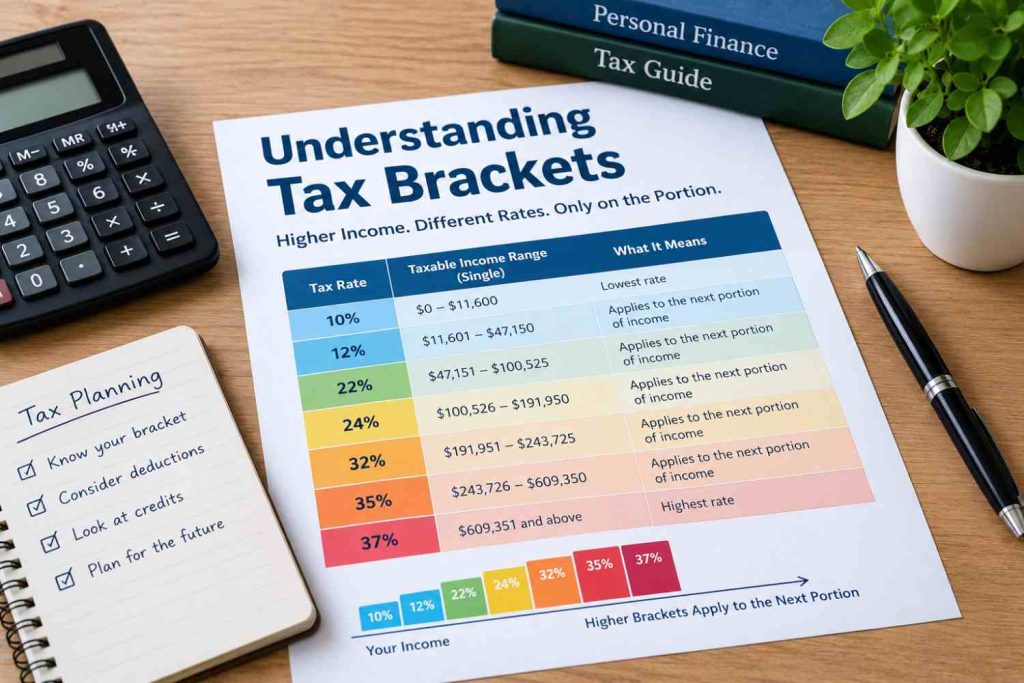
Understanding Tax Brackets is an important part of learning how the U.S. federal income tax system works. However, many taxpayers mistakenly believe that moving into a higher tax bracket means every dollar they earn will be taxed at that higher rate. In reality, the federal income tax system uses marginal rates, so different portions of taxable income can be taxed at different rates.
For this reason, knowing how tax brackets work can help taxpayers make better financial decisions. For example, the concept can be useful when evaluating a raise, bonus, investment income, or other additional earnings.
At the same time, tax brackets represent only one part of the overall calculation. Filing status, taxable income, deductions, credits, withholding, and other tax rules can also affect the final amount a taxpayer owes.
This guide explains how tax brackets work, why they matter, how marginal and effective tax rates differ, and what taxpayers should consider when preparing a federal income tax return.
What Are Tax Brackets?
Tax brackets are ranges of taxable income associated with specific federal income tax rates.
The U.S. federal income tax system is progressive. In other words, the government divides taxable income into portions and applies different marginal rates to those portions.
Currently, the federal individual income tax system includes seven marginal rates:
- 10%
- 12%
- 22%
- 24%
- 32%
- 35%
- 37%
The rate that applies to a taxpayer depends primarily on filing status and taxable income.
Importantly, reaching a higher bracket does not mean that the higher percentage applies to every dollar of income. Instead, the higher rate generally applies only to the portion that falls within that particular bracket.
Therefore, taxpayers should focus on how the brackets work together rather than looking at one rate in isolation.
How Do Tax Brackets Work?
The easiest way to understand tax brackets is to think of taxable income as a series of layers.
First, the lowest portion of taxable income falls into the lowest applicable bracket. Next, the tax system applies the following rate to the portion that enters the next bracket. As income continues to increase, additional portions may fall into higher brackets.
For example, a taxpayer could have some taxable income taxed at 10%, another portion taxed at 12%, and another portion taxed at 22%.
However, that taxpayer does not simply pay 22% on every dollar of taxable income. Instead, each portion remains subject to the rate assigned to its respective bracket.
As a result, moving into a higher tax bracket does not automatically cause a taxpayer’s entire income to receive the higher rate.
What Is a Marginal Tax Rate?
A marginal tax rate represents the rate that applies to the next portion of taxable income.
For example, suppose a taxpayer reaches a higher tax bracket after accounting for taxable income and applicable deductions. In that situation, only the income that enters the higher bracket generally receives the higher marginal rate.
Meanwhile, income that falls within lower brackets continues to receive the lower rates.
Therefore, a taxpayer’s marginal rate should not be confused with the percentage of total income ultimately paid in federal income tax.
This distinction becomes especially important when evaluating additional income.
What Is an Effective Tax Rate?
An effective tax rate differs from a marginal tax rate.
Generally, the effective rate represents the average percentage paid across the relevant taxable income. By contrast, the marginal rate applies to the next portion of taxable income.
For example, someone could have a marginal tax rate of 24% while paying a lower average percentage across their taxable income.
Consequently, taxpayers should not assume that their marginal bracket represents the percentage they pay on their entire income.
Marginal rate
The rate applied to the next portion of taxable income.
Effective rate
The average tax rate across the relevant income base.
A taxpayer’s marginal rate can therefore be considerably higher than their effective rate.
2024 Federal Tax Brackets
For the tax year covered by this guide, federal income tax rates ranged from 10% to 37%.
For single filers, the taxable-income brackets were:
| Tax Rate | Taxable Income Range |
|---|---|
| 10% | $0 – $11,600 |
| 12% | $11,601 – $47,150 |
| 22% | $47,151 – $100,525 |
| 24% | $100,526 – $191,950 |
| 32% | $191,951 – $243,725 |
| 35% | $243,726 – $609,350 |
| 37% | $609,351 and above |
These are taxable-income ranges, not gross salary ranges. The IRS’s official tax-rate schedules provide the calculations for each bracket and filing status.
Other filing statuses have different thresholds.
For example, married couples filing jointly generally have wider income ranges for each tax rate than single taxpayers.
Important: Tax brackets can change, and taxpayers should always use the applicable IRS tables for the tax year they are calculating.
IRS — Federal Income Tax Rates and Brackets
Tax Brackets for Different Filing Statuses
Your filing status can significantly change the tax brackets that apply to you.
The main federal filing statuses include:
- Single.
- Married filing jointly.
- Married filing separately.
- Head of household.
- Qualifying surviving spouse.
Each status has its own income thresholds.
For example, the income range for the 22% bracket is different for a single taxpayer than for a married couple filing jointly.
This means two people with exactly the same taxable income could have different federal income tax liabilities depending on their filing status.
The IRS provides separate rate schedules for the various filing statuses.
Taxable Income Is Not the Same as Salary
Another important point when Understanding Tax Brackets is recognizing the difference between gross income and taxable income.
A person’s salary does not necessarily equal their taxable income. Instead, qualifying adjustments and deductions can reduce the amount that ultimately becomes taxable.
A person’s salary may be $80,000, for example, but that does not necessarily mean their taxable income is $80,000.
Taxable income can be affected by qualifying adjustments and deductions.
A simplified calculation might look like this:
Gross Income
minus
Applicable Adjustments
minus
Applicable Deductions
equals
Taxable Income
The tax brackets then apply to the resulting taxable income.
Therefore, two people with similar salaries can potentially have different taxable incomes and different federal tax liabilities.
Standard Deduction and Tax Brackets
Taxpayers should also consider the standard deduction when calculating taxable income..
A deduction lowers the amount of income on which you calculate federal income tax.
For the tax year covered by this guide, the standard deduction amounts included:
- $14,600 for single taxpayers and married taxpayers filing separately
- $21,900 for heads of household
- $29,200 for married couples filing jointly and qualifying surviving spouses
The IRS explains that taxpayers generally choose between the standard deduction and itemized deductions, subject to the applicable rules.
This means a taxpayer’s gross income and taxable income can be substantially different.
IRS — Standard and Itemized Deductions
Tax Deductions vs. Tax Credits
Tax deductions and tax credits affect a taxpayer’s tax calculation differently.
First, a deduction generally reduces taxable income. Consequently, a deduction can reduce the amount of income exposed to the applicable tax brackets.
A tax credit works differently. Instead, a qualifying credit generally reduces the tax liability itself.
For example, a $1,000 qualifying tax credit can generally reduce a taxpayer’s tax liability by $1,000, subject to the rules for that particular credit.
Therefore, taxpayers should not assume that a $1,000 deduction and a $1,000 credit produce the same result.
Tax Deduction
A deduction generally reduces taxable income.
For example, if a taxpayer has qualifying deductions, those deductions can reduce the amount of income exposed to the federal tax brackets.
Tax Credit
A tax credit generally reduces the tax liability itself.
Some tax credits can provide a refund, depending on the credit and the taxpayer’s circumstances.
The IRS explains that deductions reduce the amount of income subject to tax, while tax credits can reduce the amount of tax owed.
Understanding this difference is important because taxpayers sometimes assume that a $1,000 deduction and a $1,000 tax credit have the same effect. They generally do not.
Why Moving Into a Higher Tax Bracket Does Not Mean Losing Money
One common misconception is that earning additional income can make someone financially worse off because their entire income will supposedly be taxed at the higher rate.
However, marginal tax brackets do not work that way.
Suppose additional taxable income pushes part of a taxpayer’s income into a higher bracket. In that case, the higher rate generally applies only to that additional portion.
Meanwhile, the income remaining in the lower brackets continues to receive the lower rates.
Therefore, earning more taxable income generally does not cause the taxpayer’s entire income to suddenly become subject to the highest marginal rate reached.
This is one of the most important concepts in Understanding Tax Brackets.
A Simple Tax Bracket Example
Consider a simplified example involving a hypothetical single taxpayer.
Suppose the taxpayer has $70,000 of taxable income.
The taxpayer does not simply calculate:
$70,000 × 22%
and call that the federal income tax.
Instead, the tax system divides taxable income across the applicable brackets.
The first portion is taxed at 10%.
The next portion is taxed at 12%.
The amount falling into the 22% bracket is then taxed at 22%.
The result is a progressive tax calculation, not a flat 22% tax on the entire $70,000.
This example is simplified for educational purposes. Actual tax calculations can involve deductions, credits, special tax rules, capital gains, additional taxes, and other factors.
What Happens When You Get a Raise?
A raise does not normally mean that your entire salary is suddenly taxed at the new marginal rate.
Instead, the additional taxable income is generally taxed according to the bracket into which it falls.
For example, suppose a taxpayer receives a salary increase that adds $5,000 to taxable income.
If part or all of that additional amount falls into a higher bracket, the higher rate applies only to the applicable portion.
This is why taxpayers should evaluate after-tax income, rather than assuming that entering a higher bracket makes a raise financially pointless.
A higher salary can still increase take-home income even when some additional income is taxed at a higher marginal rate.
How Withholding Relates to Tax Brackets
Tax withholding is the amount withheld from certain payments, such as an employee’s paycheck, and sent to the government on the taxpayer’s behalf.
Withholding is designed to help taxpayers pay federal income tax throughout the year.
The IRS describes the federal income tax system as a pay-as-you-go system, meaning taxpayers generally pay taxes as they earn or receive income through withholding or estimated payments.
Withholding is not the same thing as your final tax liability.
When you file a tax return, your actual tax is calculated and compared with the amount already paid.
If you paid more than required, you may receive a refund.
If you paid less, you may owe additional tax.
Research Data: Millions of Tax Returns Are Processed
The size of the federal tax system demonstrates why understanding tax calculations matters.
IRS filing-season statistics reported approximately 144 million individual tax returns received and more than 141 million returns processed during the filing season at the point measured in the relevant reporting period. The IRS also reported more than 137 million electronically filed returns.
The same IRS statistics reported approximately 93.9 million refunds, totaling roughly $269.5 billion, with an average refund of about $2,869.
These numbers show the enormous scale of the federal individual income tax system and why accurate calculations and understandable tax information are important to millions of taxpayers.
IRS — Filing Season Statistics
Tax Brackets and Capital Gains
Not every type of income is necessarily taxed using the ordinary income tax brackets.
Long-term capital gains, for example, can be subject to different federal tax rates depending on taxable income and other circumstances.
Qualified dividends can also receive preferential tax treatment.
This means taxpayers with significant investment income should not assume that the ordinary income tax brackets tell the entire story.
Other provisions of the tax code can also affect how investment income is taxed.
For taxpayers with substantial investments, professional tax guidance may be appropriate.
Tax Brackets and Self-Employment
Self-employed individuals need to consider more than ordinary federal income tax brackets.
A self-employed person may have:
- Business income.
- Deductible business expenses.
- Self-employment tax.
- Estimated tax payments.
- Qualified business-related deductions.
- Other tax obligations.
The federal income tax calculation and self-employment tax are separate concepts.
This means a freelancer or business owner should not estimate their entire tax burden simply by looking at their marginal income tax bracket.
How Tax Brackets Can Affect Financial Planning
Understanding Tax Brackets can help taxpayers make more informed financial decisions.
For example, a taxpayer may consider how additional income affects their marginal rate when evaluating:
- A bonus.
- A salary increase.
- Overtime.
- Investment sales.
- Retirement withdrawals.
- Business income.
- Taxable distributions.
However, tax brackets should not be the only consideration.
A financial decision that produces taxable income may still be beneficial even if the income reaches a higher bracket.
The goal should be to understand the complete after-tax financial result.
Common Tax Bracket Mistakes
Mistake 1: Believing the Highest Rate Applies to Everything
This is perhaps the most common misunderstanding.
Marginal tax rates apply to portions of taxable income.
Mistake 2: Confusing Gross Income With Taxable Income
Tax brackets are based on taxable income rather than simply looking at salary or total receipts.
Mistake 3: Ignoring Filing Status
Different filing statuses have different tax brackets.
Mistake 4: Forgetting Deductions
Deductions can reduce taxable income and therefore affect where income falls within the brackets.
Mistake 5: Confusing Tax Credits With Deductions
Credits and deductions affect tax calculations differently.
Mistake 6: Assuming a Tax Bracket Equals an Effective Tax Rate
A marginal rate is not the same as the average rate paid across taxable income.
Mistake 7: Using Outdated Tax Tables
Tax brackets are adjusted over time. Taxpayers should always check the IRS schedules that apply to their tax situation.
How to Use Tax Brackets for Better Planning
Tax brackets can become a useful planning tool when combined with accurate income estimates.
1. Estimate Taxable Income
Start by estimating total income and subtracting applicable adjustments and deductions.
2. Identify Filing Status
Determine the filing status that legally applies.
3. Locate the Applicable Brackets
Use the IRS tax-rate tables for the relevant tax year.
4. Estimate Marginal Tax
Determine which bracket applies to the next portion of taxable income.
5. Review Deductions and Credits
Check whether you qualify for deductions or tax credits that could reduce your tax liability.
6. Check Withholding
Review whether enough federal income tax is being withheld from your income.
7. Consider Major Financial Changes
A new job, raise, business, investment sale, marriage, or retirement can change your tax situation.
Tax Bracket Checklist
Before making an important financial decision, taxpayers can review the following:
- Identify your filing status.
- Estimate total income.
- Determine taxable income.
- Review the applicable tax brackets.
- Understand your marginal tax rate.
- Estimate your effective tax rate.
- Review available deductions.
- Check applicable tax credits.
- Review federal withholding.
- Consider estimated tax payments if necessary.
- Keep accurate financial records.
- Use the correct IRS tax tables.
Frequently Asked Questions About Understanding Tax Brackets
What is a tax bracket?
A tax bracket is an income range associated with a particular marginal federal income tax rate.
Does entering a higher tax bracket mean all income is taxed at that rate?
No. Under the progressive federal income tax system, the higher marginal rate generally applies only to the portion of taxable income that falls within that bracket.
What is the highest federal income tax rate?
The highest individual federal marginal income tax rate is 37% under the rate structure covered by this guide.
What is the difference between marginal and effective tax rates?
The marginal tax rate applies to the next portion of taxable income, while the effective tax rate represents an average rate across the relevant income.
Do tax brackets apply to gross income?
Generally, The IRS applies tax brackets to taxable income rather than simply gross income.
Can a tax deduction move someone into a lower bracket?
A qualifying deduction can reduce taxable income. As a result, it may reduce the amount of income subject to higher marginal rates.
Can a tax credit move someone into a lower tax bracket?
A tax credit generally reduces tax liability rather than reducing taxable income. Therefore, it generally does not change the tax bracket itself.
Does getting a raise cause the entire salary to be taxed at a higher rate?
No. Only the applicable portion of taxable income that reaches the higher bracket is subject to that higher marginal rate.
Should I make financial decisions based only on my tax bracket?
No. Tax brackets are useful, but when making financial decisions, consider deductions, credits, investment rules, other taxes, cash flow, and your individual circumstances.
Final Thoughts
Understanding Tax Brackets can remove much of the confusion surrounding federal income taxes. The most important concept to remember is that the United States uses a progressive tax structure, meaning Federal tax rules apply different marginal rates to different portions of taxable income.
Your tax bracket is not the same as the percentage of your entire income that you pay in federal income tax. Taxable income, filing status, deductions, credits, investment income, and other factors can all affect your final tax liability.
Knowing your marginal tax rate can help you better evaluate raises, bonuses, investment decisions, retirement income, and other financial changes. It can also make it easier to understand why your tax bill may differ from what you expected based solely on your salary.
The best approach is to use current IRS information, maintain accurate records, and consider professional tax advice when your financial situation becomes complicated.
Important: This article is provided for general educational purposes and does not constitute tax, legal, accounting, or financial advice. Federal tax rules can change, and individual tax results depend on personal circumstances. Consult the IRS or a qualified tax professional for guidance regarding your specific situation.