

When debt becomes difficult to manage, even ordinary expenses can create financial stress. Credit card balances, medical bills, personal loans, and missed payments may continue to grow while income remains limited. For some Americans, negotiating with creditors or adjusting a household budget may be enough. For others, a legal solution may be necessary.
Chapter 7 Bankruptcy Explained means understanding a federal legal process commonly known as liquidation bankruptcy. It allows eligible individuals to seek relief from many qualifying debts. A court-appointed trustee reviews the debtor’s financial affairs and may sell nonexempt assets to distribute proceeds to creditors. Many individual cases, however, involve little or no property available for liquidation.
Chapter 7 can offer a fresh financial start, but it does not erase every debt or guarantee that a person will keep all their property. Eligibility requirements, state exemption laws, and the circumstances of each case all matter.
This guide explains how Chapter 7 works, who may qualify, what happens to assets and debts, and what to consider before filing in the United States.
What Are the Eligibility Requirements for Chapter 7?
Not everyone who has financial difficulties automatically qualifies for Chapter 7. Individuals must meet the applicable legal requirements, and their financial circumstances may determine whether they can proceed under this chapter.
The means test
One important consideration is the Chapter 7 means test. For individuals whose debts are primarily consumer debts, the test helps determine whether their financial circumstances create a presumption of abuse under the Bankruptcy Code.
The calculation considers income over a specified period, allowable expenses, and other statutory factors. If income exceeds the applicable state median, additional calculations may be required. Having income above the median does not automatically disqualify someone from filing.
Other factors, including previous bankruptcy cases, may also affect eligibility.
Credit counseling
Individual debtors generally must complete an approved credit-counseling briefing within 180 days before filing. Certain statutory exceptions may apply.
Complete and accurate financial disclosures
Applicants must disclose their financial circumstances, including creditors, income, property, and living expenses. Concealing assets, providing false information, or failing to cooperate with the trustee can have serious legal consequences.
Because eligibility can be complicated, consult a qualified bankruptcy attorney before deciding whether to file.
Official reference: U.S. Courts — Chapter 7 Bankruptcy Basics.
What Happens to Your Property?
A common concern is whether filing Chapter 7 means losing your home, car, savings, or personal belongings. The answer depends on the property’s value, any outstanding loans, and the exemptions available under applicable law.
Exempt property
Bankruptcy exemption laws allow eligible debtors to protect certain assets from creditors. Depending on the jurisdiction and applicable rules, exemptions may cover some home equity, a vehicle, household goods, retirement assets, and personal belongings.
Exemptions have limits, and the rules vary by state. Some states require debtors to use state exemptions, while others allow eligible debtors to choose between state and federal exemptions.
Nonexempt property
A trustee may sell nonexempt assets and distribute the proceeds to creditors according to bankruptcy law. The fact that an asset has value does not necessarily mean the trustee will sell it; the available equity, costs, liens, and other circumstances can matter.
What about a financed car or home?
A bankruptcy discharge generally does not eliminate a valid lien against collateral. A lender may retain rights in a vehicle or home even when the debtor’s personal liability for the loan is discharged.
If you want to keep secured property, you should understand your payment obligations and available legal options before filing.
Important: Do not transfer property to relatives, conceal assets, or make unusual financial transactions to avoid creditors. Such actions may create additional legal problems.
What Debts Can Be Discharged Under Chapter 7?
Chapter 7 may eliminate personal liability for many unsecured debts, but exceptions apply.
| Debt | General treatment |
|---|---|
| Credit card balances | Often dischargeable |
| Medical expenses | Often dischargeable |
| Personal loans | Often dischargeable |
| Certain tax debts | May qualify under specific conditions |
| Child support and alimony | Generally not dischargeable |
| Most student loans | Generally require an undue-hardship determination |
| Certain fraud-related debts | May be nondischargeable |
| Secured loans | Personal liability and liens are treated differently |
For instance, a person may receive a discharge of eligible medical bills while continuing to owe child support. Similarly, discharging personal liability on a car loan does not necessarily mean the debtor can keep the vehicle without addressing the lender’s security interest.
The exact outcome depends on the nature of each debt, statutory exceptions, and whether a creditor or court takes further action.
How Long Does Chapter 7 Take?
Many straightforward individual Chapter 7 cases move relatively quickly compared with repayment-based bankruptcy cases.
A discharge is often issued approximately 60 to 90 days after the date first set for the meeting of creditors, provided the requirements are satisfied and no issue delays the process. The overall case may continue longer if the trustee must administer assets or disputes arise.
The typical process includes:
- Preparing and filing the petition and required financial schedules.
- Receiving notice of the case and the meeting of creditors.
- Attending the meeting and answering questions about finances and property.
- Completing the required debtor-education course.
- Addressing any outstanding issues before the court grants a discharge.
The timeline is not guaranteed. Incomplete paperwork, objections, asset administration, or other complications may delay the case.
What Are the Benefits and Risks?
Before making a decision, compare the potential advantages with the long-term consequences.
Potential benefits
- Relief from many qualifying unsecured debts.
- A legal process that pauses many collection actions.
- An opportunity to regain control of household finances.
- A potential fresh start without a multiyear repayment plan.
Potential drawbacks
- Possible liquidation of nonexempt property.
- Filing costs and potential attorney fees.
- A bankruptcy record that may remain on credit reports for years.
- Continued responsibility for certain nondischargeable debts.
- Possible difficulty obtaining new credit on favorable terms.
The right choice depends on whether the relief available outweighs the financial and legal consequences for your particular situation.
Research Data: Chapter 7 Filings Before July 2024
Official statistics from the Administrative Office of the U.S. Courts provide useful context for understanding the use of Chapter 7.
In its report published on April 25, 2024, the federal judiciary reported 271,825 Chapter 7 filings for the 12 months ending March 31, 2024, compared with 231,200 for the preceding 12-month period. That represents an increase of approximately 17.6%.
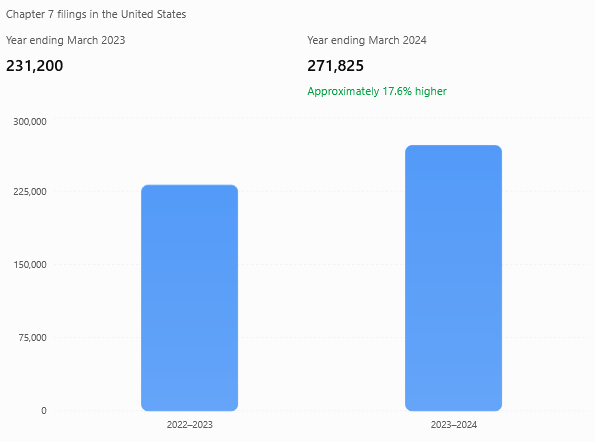
Source: Administrative Office of the U.S. Courts, April 25, 2024.
Source: U.S. Courts — Bankruptcies Rise 16 Percent Over Previous Year.
These figures show that Chapter 7 filings increased during the period covered by the report. However, they do not establish why individual debtors filed or whether filing was the best financial choice for them. The statistics are included because they were published before the article’s July 8, 2024 publication date.
Are There Alternatives to Chapter 7?
Before filing, consider whether another approach could address your financial difficulties.
- Debt negotiation: Contact creditors to ask whether they can offer reduced interest rates, adjusted payment schedules, or settlement arrangements.
- Credit counseling: A reputable nonprofit credit counseling agency may help you develop a budget and evaluate debt-management options.
- Debt consolidation: Combining eligible debts into one loan may simplify repayment, although fees and interest costs must be considered.
- Chapter 13 bankruptcy: Eligible individuals with regular income may be able to repay debts through a court-approved plan over three to five years.
- Financial budgeting: If the debt is manageable, reducing expenses and increasing income may help you avoid additional borrowing.
These alternatives are not suitable for everyone. If collection lawsuits, foreclosure, repossession, or wage garnishment are concerns, obtain advice promptly because deadlines and legal protections may vary.
Frequently Asked Questions
1. What is Chapter 7 bankruptcy in simple terms?
It is a federal legal process that allows eligible individuals to seek relief from many qualifying debts. A trustee may sell nonexempt assets to pay creditors, and an eligible individual may receive a discharge of certain remaining debts.
2. Will I lose everything if I file?
No. Applicable exemption laws may protect some property. However, nonexempt assets may be sold, and secured creditors may retain rights against collateral. The result depends on your circumstances and the laws that apply.
3. Can I keep my car?
Possibly. Your vehicle’s equity, applicable exemptions, loan status, and ability to meet ongoing obligations all matter. A bankruptcy discharge does not automatically remove a lender’s lien.
4. Does Chapter 7 eliminate student loans?
Most student loans are not automatically discharged. A debtor generally must establish undue hardship through the applicable legal process, although the outcome depends on the circumstances.
5. How long does Chapter 7 remain on a credit report?
Under the Fair Credit Reporting Act, bankruptcy information may generally be reported for up to 10 years. The exact reporting period and credit impact depend on the applicable circumstances.
6. Can I file without an attorney?
Individuals may file without a lawyer, but bankruptcy involves detailed forms, eligibility requirements, and legal consequences. Professional guidance can be particularly useful when property, tax debts, or secured loans are involved.
7. Is Chapter 7 better than Chapter 13?
Neither chapter is universally better. Chapter 7 may suit eligible individuals seeking relief from qualifying debts, while Chapter 13 may be more appropriate for eligible people who need a repayment plan or time to catch up on certain secured obligations.
Conclusion
Chapter 7 Bankruptcy Explained helps readers understand a legal option available to eligible Americans facing overwhelming debt. The process may provide relief from many qualifying unsecured debts, but it also carries risks involving property, credit history, and obligations that cannot be discharged.
Before making a decision, review your income, assets, debts, and available exemptions. Compare Chapter 7 with other debt-relief options and seek guidance from a qualified bankruptcy attorney or reputable credit counselor when necessary.
A clear understanding of the rules can help you make a more informed decision about your financial future.
Research sources
1. U.S. Courts — Chapter 7 Bankruptcy Basics: Official information on liquidation, eligibility, exemptions, the means test, and discharge. https://www.uscourts.gov/court-programs/bankruptcy/bankruptcy-basics/chapter-7-bankruptcy-basics
2. U.S. Courts — Bankruptcies Rise 16 Percent Over Previous Year: Official filing statistics published April 25, 2024. https://www.uscourts.gov/data-news/judiciary-news/2024/04/25/bankruptcies-rise-16-percent-over-previous-year
3. U.S. Courts — Bankruptcy Process: An overview of the procedures involved in bankruptcy cases. https://www.uscourts.gov/court-programs/bankruptcy/bankruptcy-basics/process-bankruptcy-basics