
Chapter 13 is not available to everyone. Before filing, individuals should review their income, debt balances, prior bankruptcy history, and other eligibility requirements.
Who can file?
Generally, Chapter 13 is available to individuals, including eligible self-employed people, who have a regular source of income and meet the statutory debt limits. The rules also address prior bankruptcy dismissals and required credit counseling.
Debt limits can change over time, so applicants should verify the limits applicable on their filing date rather than rely on older figures.
How to file
The process commonly includes these steps:
- Review your finances: List debts, assets, income, expenses, and any overdue mortgage or vehicle payments.
- Complete credit counseling: Use an approved agency unless a legal exception applies.
- Prepare the paperwork: Complete the petition, financial schedules, and proposed repayment plan.
- File with the bankruptcy court: Submit the required documents and applicable filing fees.
- Begin plan payments: Payments generally must start within 30 days of filing, even if the plan has not yet been confirmed.
- Attend the creditors’ meeting: Answer questions from the trustee and creditors about your finances and proposed plan.
- Obtain court approval: The court reviews whether the plan satisfies legal requirements and is feasible.
- Follow the confirmed plan: Make payments on time and meet continuing obligations throughout the repayment period.
Incomplete information or missed payments can delay the case or lead to dismissal or conversion to another bankruptcy chapter. Professional guidance can help you understand the requirements that apply to your situation.
Research Data: Bankruptcy Filings in the United States
The Administrative Office of the U.S. Courts published bankruptcy statistics on April 25, 2024, covering the 12-month period ending March 31, 2024.
During that period, U.S. courts received 187,539 Chapter 13 bankruptcy filings, compared with 166,449 during the preceding 12-month period. That represents an increase of approximately 12.7%.
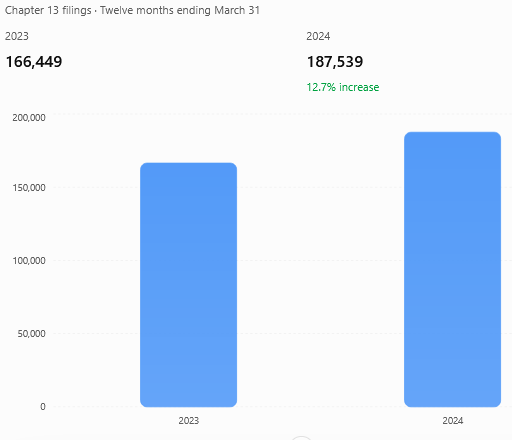
Source: Administrative Office of the U.S. Courts, April 25, 2024.
Source: U.S. Courts — Bankruptcy Filings Rise 16 Percent Over Previous Year.
These statistics show that Chapter 13 filings increased over the reported period. They do not, by themselves, explain the reasons people filed or prove that a repayment plan is the best option for every debtor.
Benefits of Chapter 13 Bankruptcy
Chapter 13 can offer practical advantages for eligible people who have regular income but need additional time to address their debts.
- Potential protection against foreclosure: The automatic stay generally pauses foreclosure activity when a case is filed, subject to exceptions. A qualifying homeowner may be able to catch up on overdue payments through the plan.
- Opportunity to retain property: Unlike Chapter 7 liquidation, Chapter 13 can allow debtors to retain property while making the required payments.
- Structured repayment: One regular payment to the trustee can simplify the distribution of funds to creditors.
- Possible protection for co-debtors: Special rules may protect certain individuals who are jointly liable for qualifying consumer debts.
- Time to reorganize finances: A repayment plan provides a defined period to address eligible debts while maintaining a realistic household budget.
These advantages depend on the court’s approval and the debtor’s ability to comply with the plan.
Disadvantages of Chapter 13 Bankruptcy
Despite its benefits, Chapter 13 requires a long-term commitment.
Three to five years of payments: Debtors must maintain a repayment plan for an extended period, which can be difficult if income falls or unexpected expenses arise.
Ongoing mortgage and other obligations: A plan does not automatically eliminate regular mortgage payments or every secured debt. Some obligations must continue to be paid outside or alongside the plan.
Legal and administrative costs: Court fees, attorney fees, and other expenses may add to financial pressure.
Consequences of missed payments: Failure to comply with the plan may result in dismissal or conversion of the case, potentially affecting the protection it provided.
Limitations on new borrowing: Taking on additional debt during the case may require consultation with the trustee or court approval, depending on the circumstances.
Before filing, consider whether your income is sufficiently stable to support the proposed plan and ordinary living expenses.
What Happens After Completing Chapter 13?
A debtor who completes the required plan payments and satisfies the applicable legal conditions may qualify for a bankruptcy discharge.
The discharge generally releases the debtor from covered debts, subject to statutory exceptions. Certain long-term obligations, domestic support obligations, and other specified debts may remain payable.
If financial circumstances change during the plan, a debtor may be able to request a modification, depending on the circumstances and legal requirements. It is important to communicate with your attorney and trustee promptly rather than simply stop making payments.
Frequently Asked Questions
1. What is Chapter 13 bankruptcy?
Chapter 13 is a federal bankruptcy process that allows eligible individuals with regular income to propose a repayment plan lasting generally three to five years. It can help people address debts while potentially retaining property.
2. Can Chapter 13 stop foreclosure?
Filing generally triggers an automatic stay that pauses many foreclosure actions. However, exceptions apply, and timing matters. If a foreclosure sale has already occurred, filing may not reverse it. Obtain legal advice immediately if you are facing foreclosure.
3. Do I have to repay all my debts?
Not necessarily. The amount paid depends on the plan, the type of debt, income, assets, and other legal requirements. Certain priority claims generally receive special treatment, while eligible unsecured creditors may receive less than the full amount owed.
4. How long does Chapter 13 last?
Repayment plans generally last three to five years. The appropriate duration depends on income and applicable bankruptcy requirements.
5. Can I keep my car?
Possibly. The outcome depends on the loan, the plan, the vehicle’s value, and whether you can meet the required payments. A secured creditor may retain rights against the vehicle.
6. What happens if I miss a plan payment?
Missing payments can jeopardize the case. Depending on the circumstances, the court may dismiss the case or convert it to Chapter 7. If you anticipate financial difficulty, seek advice promptly to determine whether a plan modification or another remedy is available.
7. Is Chapter 13 better than Chapter 7?
Neither option is universally better. Chapter 13 may suit eligible individuals who have regular income and need a repayment plan, while Chapter 7 may be more appropriate for certain people seeking relief through liquidation and discharge of eligible debts. A professional can help compare the options.
Conclusion
A Chapter 13 Bankruptcy Guide can help Americans understand how a court-supervised repayment plan may provide a way forward when debts become difficult to manage. For eligible individuals, Chapter 13 can offer time to repay obligations, address certain mortgage arrears, and potentially retain valuable property.
However, the process requires consistent payments, accurate financial disclosures, and compliance with court requirements. Before filing, review your financial situation, compare alternatives, and consult a qualified bankruptcy attorney if possible.
Understanding the rules and planning realistically can help you decide whether Chapter 13 is a suitable step toward greater financial stability.