

A Chapter 11 Bankruptcy Overview helps business owners, company directors, investors, and individuals understand a federal legal process designed primarily to reorganize debts while allowing operations to continue when feasible.
Chapter 11 is commonly used by businesses that need time to negotiate with creditors and develop a workable financial plan. It can also be available to individuals with complex financial situations who meet the applicable requirements. Filing does not automatically guarantee that a company will survive, and the process can be expensive and demanding.
Understanding how Chapter 11 works, what happens after filing, and how a reorganization plan is approved can help debtors make more informed decisions during financial distress.
What Is Chapter 11 Bankruptcy?
Chapter 11 is a form of bankruptcy under Title 11 of the United States Code. It allows a debtor to reorganize financial obligations under court supervision rather than necessarily liquidating the business immediately.
Although it is most commonly associated with corporations, Chapter 11 may also be available to partnerships, sole proprietors, and individuals who meet the applicable requirements.
The central idea is to create a workable plan for addressing debts while preserving value where possible. A company may renegotiate certain obligations, seek new financing with court approval, close unprofitable operations, or sell assets as part of its restructuring strategy.
For example, imagine a regional retailer with several profitable stores but substantial overdue rent and supplier invoices. If the business can generate enough revenue to operate after restructuring, Chapter 11 may give it an opportunity to negotiate with creditors and develop a plan to move forward.
However, reorganization is not guaranteed to succeed. If the business cannot secure financing, maintain operations, or obtain approval for a feasible plan, it may eventually be sold, liquidated, or converted to another bankruptcy chapter.
The U.S. Department of Justice provides an official explanation of the process through its Overview of Bankruptcy Chapters.
Who Can File for Chapter 11 Bankruptcy?
Chapter 11 is available to a range of debtors, although the eligibility requirements and procedures depend on the type of entity and its financial circumstances.
Corporations
Corporations may use Chapter 11 to restructure loans, supplier obligations, lease commitments, and other business debts. Management often continues operating the company while working toward a reorganization plan, subject to court oversight.
Partnerships and sole proprietors
Partnerships and sole proprietors may also qualify. The distinction between personal and business liabilities is especially important for sole proprietors because the business and its owner are not separate legal entities in the same way as a corporation.
Individuals with complex financial circumstances
Individuals may file under Chapter 11 when their financial situation makes it appropriate and they meet the applicable legal requirements. This may include people whose debts exceed the limits for Chapter 13 or who have complicated financial arrangements.
Small businesses
Eligible small businesses may be able to use Subchapter V of Chapter 11. This option provides certain streamlined procedures intended to make reorganization more practical for qualifying small business debtors.
Subchapter V has specific eligibility rules and debt limits. The applicable limits changed on June 21, 2024, so a debtor filing around the publication date should verify the requirements in effect at that time.
Official resource: U.S. Trustee Program — Chapter 11 Information.
How Does the Chapter 11 Process Work?
A Chapter 11 case involves several stages. The exact procedure depends on the debtor’s circumstances, the applicable bankruptcy rules, and whether the case proceeds under ordinary Chapter 11 or Subchapter V.
1. Assess the financial situation
Before filing, the debtor should examine cash flow, outstanding loans, unpaid taxes, lease commitments, operating expenses, assets, and creditor claims.
This review helps determine whether reorganization is realistic. A business that cannot generate enough money to pay essential operating expenses may need a different strategy.
2. File the bankruptcy petition
The debtor files a petition with the appropriate federal bankruptcy court. The filing generally includes financial disclosures and other required documents.
Once the case begins, an automatic stay generally pauses many collection actions. However, exceptions apply, and some actions may continue or be authorized by the court.
3. Continue operating under court supervision
In many Chapter 11 cases, the debtor remains in possession of its assets and continues running the business. Management assumes certain responsibilities ordinarily performed by a bankruptcy trustee.
The debtor must comply with reporting requirements and court orders. Certain transactions, financing arrangements, and asset sales may require court approval.
4. Develop a reorganization plan
The debtor develops a plan explaining how it intends to address creditor claims and restructure its financial obligations.
The plan may propose changes to loan terms, repayment schedules, leases, or business operations. Creditors may be divided into classes according to the legal treatment of their claims.
5. Obtain creditor and court approval
Depending on the case, affected creditor classes may vote on the plan. The court must determine whether the plan satisfies the applicable legal requirements before confirming it.
A plan does not necessarily require every creditor to agree, but confirmation without unanimous approval is subject to specific statutory conditions.
6. Implement the plan
After confirmation, the debtor must follow the plan’s terms. This may involve making payments over time, selling assets, changing operations, or meeting other obligations.
Failure to implement the plan can result in further legal proceedings and may undermine the reorganization.
What Is a Reorganization Plan?
A reorganization plan is the document that explains how a debtor intends to resolve its financial obligations and move forward.
Depending on the circumstances, it may include:
- Debt restructuring: Changing repayment terms where legally permitted.
- Creditor payments: Explaining when and how different creditor classes will be paid.
- Business changes: Closing locations, reducing expenses, or discontinuing unprofitable products.
- Asset sales: Selling selected property or business units to generate funds.
- New financing: Obtaining financing to support continued operations, subject to applicable requirements.
- Future financial commitments: Setting out the obligations the debtor must meet after confirmation.
A successful plan must be more than a proposal that looks attractive on paper. It needs to satisfy the legal requirements and offer a realistic path to implementation.
For example, a manufacturing company might propose extending loan repayment periods, renegotiating supplier contracts, and selling an unused facility. If the revised business can generate sufficient cash flow, the plan may give the company an opportunity to continue operating.
Research Data: Chapter 11 Filings in the United States
Official federal court statistics demonstrate that Chapter 11 is an established part of the U.S. bankruptcy system.
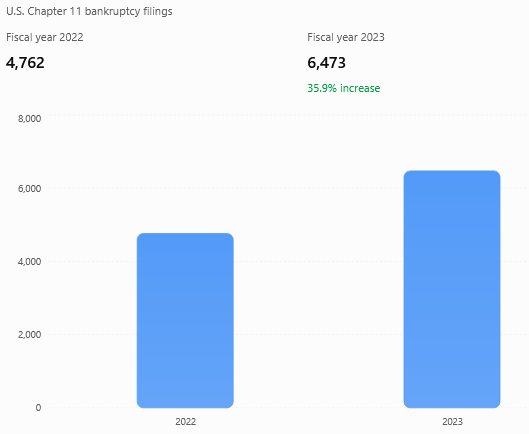
According to the U.S. Courts’ Judicial Business 2023 report, Chapter 11 filings increased by approximately 36% in fiscal year 2023, reaching 6,473 cases compared with 4,762 in fiscal year 2022.
Source: Administrative Office of the U.S. Courts, Judicial Business 2023.
Source: U.S. Courts — Judicial Business 2023
The increase shows that more Chapter 11 cases were filed in fiscal year 2023 than in the previous fiscal year. It does not establish why individual debtors filed or whether their reorganizations succeeded.
The report was available before July 15, 2024, making it suitable historical research for this article.
What Are the Benefits of Chapter 11?
Chapter 11 can provide several potential advantages when a business has a viable path to recovery.
Opportunity to continue operating: A company may be able to keep serving customers and generating revenue while restructuring its obligations.
Temporary protection from many collection actions: The automatic stay can give the debtor time to assess its finances and pursue a reorganization strategy, subject to statutory exceptions.
Ability to restructure debts: The process may allow the debtor to propose revised payment terms and address creditor claims through a court-supervised plan.
Preservation of business value: Continuing operations may preserve jobs, customer relationships, intellectual property, and other valuable business assets.
A structured process for resolving disputes: Bankruptcy provides procedures for dealing with creditor claims and disagreements over the proposed plan.
These benefits are not guaranteed. The business needs a realistic restructuring strategy, and the costs and risks of proceeding must be considered carefully.
What Are the Disadvantages and Risks?
Chapter 11 is a complex legal process that can place significant demands on a debtor.
High costs
Legal representation, financial advisers, court filings, reporting requirements, and other administrative expenses can be substantial. These costs may be particularly difficult for a company already struggling with cash flow.
Operational disruption
Customers, suppliers, lenders, employees, and investors may become concerned about the company’s financial stability. Some business relationships may change during the proceedings.
Court oversight
Management may continue running the business, but it must comply with bankruptcy law and court orders. Certain decisions may require court approval.
No guarantee of success
A reorganization plan may fail if the business cannot generate sufficient revenue, obtain necessary financing, or meet its obligations. In some cases, the business may close or its assets may be liquidated.
Long and complicated proceedings
The timeline varies substantially. A straightforward case may move more quickly, while complex cases involving many creditors, disputed claims, or extensive negotiations may take months or longer.
Businesses should assess these risks before deciding whether Chapter 11 offers a realistic solution.
Chapter 11 vs. Chapter 7: What Is the Difference?
Although both chapters fall under the U.S. Bankruptcy Code, they serve different purposes.
| Feature | Chapter 11 | Chapter 7 |
|---|---|---|
| Primary purpose | Reorganization | Liquidation |
| Business operations | May continue | Often cease or are sold, although circumstances vary |
| Assets | May be retained or sold under the plan and applicable rules | Nonexempt assets may be liquidated |
| Debt resolution | Usually through a reorganization plan | Through liquidation and applicable discharge rules |
| Typical use | Businesses seeking restructuring; certain individuals | Businesses and individuals seeking liquidation-based relief |
| Complexity | Often more complex and expensive | Often simpler, though case complexity varies |
Chapter 11 may be appropriate when a debtor has a viable path to restructure and continue. Chapter 7 may be more suitable when continued operations are not feasible or liquidation is the appropriate route.
The right option depends on the debtor’s goals, financial position, and legal circumstances.
Frequently Asked Questions
1. What is Chapter 11 bankruptcy used for?
It is primarily used to reorganize financial obligations while allowing a business to continue operating when feasible. Eligible individuals may also use it in certain circumstances.
2. Can a business continue operating during Chapter 11?
Yes. In many cases, the debtor continues operating as a debtor in possession under court supervision. Certain actions may require court approval, and the business must meet its reporting and other legal obligations.
3. How long does Chapter 11 bankruptcy take?
There is no single timeline. Some cases may reach confirmation relatively quickly, while complex cases can take many months or longer. The duration depends on creditor negotiations, court proceedings, the proposed plan, and other circumstances.
4. Can small businesses file under Chapter 11?
Yes. Qualifying small businesses may be eligible for Sub-chapter V, which provides streamlined reorganization procedures. Eligibility and debt limits must be verified under the law applicable on the filing date.
5. Does Chapter 11 eliminate all business debt?
No. The treatment of debts depends on the confirmed plan and applicable bankruptcy law. Some obligations may be restructured, paid in part, or treated differently, while certain debts and liabilities may remain.
6. Can individuals file under Chapter 11?
Yes. Individuals may file under Chapter 11 when eligible, including some with complex financial circumstances or debts beyond Chapter 13 limits. The process may differ from a typical business reorganization.
7. What happens if a reorganization plan fails?
Depending on the circumstances, the court may dismiss the case, convert it to another chapter if legally permitted, or consider other available remedies. The outcome depends on the facts and applicable law.
Conclusion
A Chapter 11 Bankruptcy Overview helps business owners and individuals understand how federal bankruptcy law can provide an opportunity to reorganize financial obligations rather than immediately liquidate assets.
For a viable business, Chapter 11 may create time to renegotiate debts, adjust operations, and develop a sustainable plan. However, the process requires detailed financial disclosures, court oversight, professional support, and a realistic strategy for meeting future obligations.
Before filing, review your financial position, compare available alternatives, and consult a qualified bankruptcy attorney and financial adviser. A well-planned approach can help you evaluate whether reorganization offers a practical path toward financial recovery.