
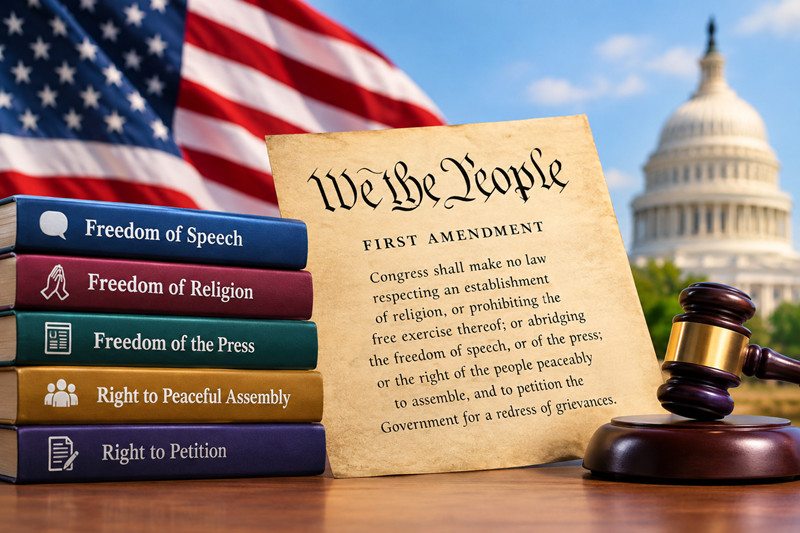
Freedom is a fundamental principle of American democracy, and the U.S. Constitution provides several protections that allow individuals to express their beliefs, practice their religion, share information, and challenge government decisions. These protections are central to the country’s legal system and democratic traditions. However, many people do not fully understand how these constitutional safeguards work in everyday situations.
First Amendment Rights protect five essential freedoms: religion, speech, the press, peaceful assembly, and the right to petition the government. These protections help individuals participate in public discussions, express unpopular opinions, and raise concerns about government policies without facing unconstitutional government restrictions.
Understanding these freedoms is particularly important in an era when online discussions, political disagreements, public demonstrations, and debates about censorship regularly make headlines. Knowing what the Constitution protects—and where its protections have limits—can help Americans make informed decisions about their rights and responsibilities.
What Does the First Amendment Protect?
The First Amendment is part of the Bill of Rights, which was ratified in 1791. Its purpose is to protect fundamental freedoms and restrict the government’s ability to interfere with certain individual liberties.
According to the U.S. Constitution Annotated, published by the Library of Congress, the amendment protects five primary freedoms.
1. Freedom of Speech
Freedom of speech allows people to express opinions, criticize public officials, discuss political issues, and participate in public debate. It also covers many forms of expression beyond spoken words, including written materials, artistic expression, and symbolic conduct.
For example, an individual may criticize a government policy, write an opinion article, or participate in a peaceful protest. The government generally cannot punish someone merely because officials disagree with the person’s viewpoint.
However, freedom of speech is not unlimited. Certain categories of expression, including incitement to imminent lawless action and legally actionable defamation, may fall outside constitutional protection under applicable legal standards.
2. Freedom of Religion
The First Amendment protects religious liberty through two clauses: the Establishment Clause and the Free Exercise Clause.
The Establishment Clause limits government involvement in establishing or endorsing religion, while the Free Exercise Clause protects religious practice, subject to applicable constitutional principles.
These protections allow people to follow different faiths, change their religious beliefs, or choose not to practice a religion. They also help safeguard religious expression from improper government interference.
3. Freedom of the Press
A free press plays an important role in informing the public, investigating government conduct, and reporting matters of public interest.
Journalists and media organizations can report on public policies, investigate allegations of misconduct, and publish criticism of public officials. These activities support transparency and accountability.
Nevertheless, press freedom does not provide blanket immunity from generally applicable laws. Depending on the circumstances, legal issues involving defamation, privacy, confidentiality, and other restrictions may arise.
4. The Right to Peaceful Assembly
The First Amendment protects the right of people to gather peacefully for political, social, and other lawful purposes.
Public demonstrations, marches, rallies, and organized meetings can give communities a way to communicate concerns and advocate for change.
Government authorities may enforce certain content-neutral rules concerning the time, place, and manner of demonstrations. Such restrictions must satisfy applicable constitutional requirements and cannot simply be used to suppress an unpopular viewpoint.
5. The Right to Petition the Government
The right to petition allows individuals and groups to ask government officials to address grievances or reconsider decisions.
People may submit complaints, contact elected representatives, participate in public hearings, and advocate for legislative changes. This freedom provides a constitutional foundation for many forms of civic participation.
Together, these five freedoms help Americans engage with public institutions and contribute to democratic decision-making.
What Does Research Say About Americans’ Understanding of These Freedoms?
Public opinion research shows that many Americans value constitutional protections but do not always understand their full scope.
According to the Freedom Forum’s 2023 Where America Stands survey, conducted in March 2023 with 801 respondents:
- 93% considered the First Amendment vital.
- 64% said they would vote to ratify the First Amendment again.
- Only 24% knew that private workplace policies are not bound by the First Amendment in the same way as government restrictions.
The survey also found that Americans were more familiar with freedom of speech than with some of the amendment’s other protections. These findings highlight the importance of public education about constitutional rights.
A separate 2023 study by the University of Pennsylvania’s Annenberg Public Policy Center found that 77% of U.S. adults could name freedom of speech when asked to identify specific rights protected by the First Amendment. Other freedoms were less frequently recalled.
Source: Annenberg Public Policy Center — 2023 Constitution Day Civics Survey.
These findings demonstrate that recognizing a constitutional right is not the same as understanding how it applies in real-world situations. Public awareness can help people distinguish protected expression from conduct that may be regulated under the law.
Do First Amendment Protections Apply to Social Media?
Social media has changed how people communicate, share information, and participate in political discussions. Platforms allow users to publish opinions, organize events, criticize public officials, and engage with people across the country.
However, a common misconception is that the First Amendment automatically prevents social media companies from removing posts or suspending accounts.
In general, the First Amendment restricts government action rather than the editorial decisions of private companies. Consequently, a private social media platform can often establish content policies and moderate material under its terms of service.
The legal analysis may become more complicated when government officials are involved in content moderation or when specific state or federal laws apply. Whether particular conduct constitutes unconstitutional government action depends on the circumstances and relevant legal precedent.
People should therefore distinguish between government censorship, private platform moderation, and other disputes involving online expression.
Are There Limits to Freedom of Speech?
Although the Constitution provides substantial protection for expression, it does not protect every statement or action in every situation.
Courts have recognized several categories and circumstances in which speech may be restricted under applicable legal standards. Examples include:
- Incitement: Speech intended and likely to produce imminent lawless action may be punishable under the standard established by the Supreme Court.
- True threats: Serious expressions of unlawful violence may fall outside First Amendment protection, subject to the applicable legal test.
- Defamation: False statements of fact that satisfy the legal requirements for defamation may lead to civil liability. Public officials and public figures generally face additional constitutional requirements.
- Obscenity: Legally defined obscenity is not protected in the same way as ordinary expressive material.
- Reasonable public regulations: Certain content-neutral rules governing the time, place, and manner of expression may be permissible when constitutional requirements are met.
These examples should not be interpreted as a complete list of all relevant exceptions or legal standards. The outcome of a dispute depends on the specific facts, applicable law, and controlling court decisions.
For authoritative legal explanations, readers can consult the Constitution Annotated, which explains constitutional provisions and relevant Supreme Court interpretations.
Why Constitutional Freedoms Matter in Everyday Life
The importance of First Amendment protections extends beyond courtrooms and political debates. These freedoms influence how people communicate, organize, learn, and participate in their communities.
For example, a resident may speak at a local government meeting to oppose a proposed development. A journalist may investigate the use of public funds. A religious community may gather for worship, while an advocacy group may organize a peaceful march to support legislative reform.
In each situation, constitutional protections can help individuals express their views and participate in public life.
These freedoms also support the exchange of ideas in educational institutions, community organizations, and public forums. Disagreement is a normal part of a diverse society, and constitutional principles help establish boundaries for government involvement in expression.
At the same time, exercising these freedoms responsibly means understanding applicable laws, respecting the rights of others, and recognizing that constitutional protections do not eliminate every legal or practical consequence of expressing an opinion.
What Should You Do If You Believe Your Rights Have Been Violated?
If you believe a government agency, public institution, or official has improperly restricted your constitutional freedoms, consider taking the following steps.
Document the incident. Keep copies of relevant emails, letters, notices, policies, photographs, or other evidence. Record dates, locations, and the identities of people involved when appropriate.
Identify the government action. Determine whether the dispute involves a government entity or a private organization. This distinction can be important when assessing a First Amendment claim.
Review the applicable rules. Constitutional standards can differ depending on the circumstances, including whether the matter involves a public forum, a school, a government workplace, or another setting.
Seek qualified legal guidance. An attorney experienced in constitutional law or civil rights litigation can evaluate the facts, explain potential legal options, and identify relevant deadlines.
Not every disagreement involving speech or expression amounts to a constitutional violation. A careful review of the facts and applicable law is essential before deciding how to proceed.
Conclusion
The First Amendment remains a cornerstone of American democracy, protecting religious liberty, free expression, press freedom, peaceful assembly, and the right to petition the government. These freedoms allow individuals to participate in public life, question government decisions, and share different perspectives.
Understanding First Amendment Rights requires more than knowing the words of the Constitution. It also means recognizing the distinction between government restrictions and private decisions, understanding the limits of constitutional protection, and knowing where to find reliable legal information.
By learning about these protections and staying informed about relevant legal developments, Americans can better understand their freedoms and make more informed decisions when constitutional questions arise.
Note: This article is intended for general educational purposes and does not constitute legal advice. Specific constitutional questions should be reviewed with a qualified attorney.